Monday, November 28, 2022

Yes, I kann!

Every chessplayer knows the rollercoaster of emotions and motivation around their play. After two rounds I was believing I could win them all, and then after my round three capitulation, I was wondering if I should even bother. Chess, especially classical chess, can a very long struggle for an eventual loss; and defeats can feel, well, defeating.

Round four I came twenty minutes early to find a car crash on the road outside and not many people inside the chess centre. It was a peculiar evening. There was no-one familiar so I just sat at a playing table and played chess on my phone until the pairings were announced. The arbiter was talking to some juniors and coincidentally raised my name, presumably because one of them, possibly my opponent, asked who I was, "unrated but strong, about 1700" was his summary. And it is probably accurate. 

Once the crowd disappeared I saw my pairing was another junior, different to my last two rounds though as he was from a Pasifika background. A little search found him and his family in the news with trophies galore. At 11 he was rated much stronger than my round two opponent, close to my "1700".

Fortunately, just like my previous round's opponent, he was mature and comfortable around adults and we could chat before the game. Then it was show time and I finally got to play the opening that defeated me in the last round, the Caro-Kann, this time from the black side. 

1. e4 c6 2. Nf3 d5 3. exd5 cxd5 4. Be2 Nf6 5. O-O Bg4 6. c3 e6 7. d3 Bd6 8. Bg5

O-O 9. Nbd2 Nbd7 

The game was not any usual start to the Caro-Kann. In fact, I've never had an opponent play like it: He just set up his pieces, seemingly without trying to have them interact much with mine. He said after the game that he hadn't played against the Caro-Kann before and was just really making it up as he went along. The moniker "All pawns and no hope" comes when people attack the Kann and this wasn't yet much of a challenge. But, the young man hadn't done anything wrong. And for what it's worth, I was just setting myself up without really trying to do too much either. But now he began to make moves against me.

10. c4 

I have never seen this move in the Kann. But the more I looked at it, the more I was unsure how to deal with it. After much hesitation, I played a nothing move that I had vague plans around. Immediately he showed he had solid plans:

10. ... Re8 11. Nd4 Bxe2 12. Qxe2 Rc8 13. Nb5 Bb8 14. Kh1 a6 15. Nc3

Now, I go through these games with an engine to understand my opportunities better and to be clear around this point I was having some dread that I was being outplayed. Perhaps this is the feeling I will always have. The computer thought I had a solid edge, but all I could see was his initiative.

And it was here that happened one of those sequences where I conceive of a line and then immediately regret it thinking it was losing:

15. ... dxc4 16. Nxc4 Qc7 17. f4 Nd5 18. Ne4!?

Now, he is really getting in my face. In fact, he has a really concrete threat of planting a knight in my throat and forking my rooks that were arranged perfectly for forking on account of that nothing move earlier on. I was burning through time. He already had about a thirty minute advantage in time and what I thought was a handy advantage on the board. The amazing thing is that the engine gives me a clear advantage. I spent a ton of time looking at a rash looking pawn grab and thought after a long time that it couldn't possibly work. (It did work.) Then looked at a banal move unenthused. (It was would keep my advantage.) Then there was a move right before me that I hadn't really wanted to think about and suddenly it looked a lot better than anything else, so I played it.  18. ... f6. Amazingly all three moves are the equal best moves, all with a strong advantage but I wasn't strong enough to realise it.

What I didn't see coming was that he would throw caution to the wind a throw a haymaker: 19. Ncd6 - he went for my throat and in doing so was sacrificing a bishop. I took it, 19. ... fxg5, and then he gave his follow-up: 20. Rac1??

Image
After 20. Rac1?? - the beginning of the end for my young opponent.


It was a blunder - the kind that you have to stop and make sure it is not some elaborate trap. I'm not sure at what point he realised it was a mistake. He had attacked my queen with his rook not realising I could in fact take his attacker with impunity. If he recaptured, it would have been checkmate. So, scooting down the board my queen went to take his rook.

20. Qxc1 21. Nxe8, he moved quickly with almost the only move, and then I realised there was a possible trap. I almost moved to my logical follow up Rc2 without thought before I found an even better move: 21. ... Nxf4 

The game then went quickly downhill for him. His position to be clear had some dangerous elements but no time to stick them together: 22. Qf3 g4 23. Qf2 Rc2 24. g3 Qxb2 25. Qg1 Nh3, and he put his king on its side to indicate resignation, 0-1.

I am still amazed that the computer had me stronger for most of the game despite my intuition. I was clearly setting my pieces with a lot of latent power and that was also why, even in my middlegame frustration, almost any of the three moves were actually strong. 

He was astonishing though for his age. He could set up his forces to an opening that was unfamiliar to him and even in defeat you could see he was calculating accurately. For him, it was a one move blunder that meant I had an easier time. If he hadn't, what would have happened? The computer has me with an edge but his position would have had more life and the chance for me to make a mistake, especially since I was so far behind in time. 

Here is the game as it happened. Notice the tide turning.

Image

Tuesday, November 22, 2022

Not so fantastic

And so the prophecy of the previous blog came to be: I went into the chess hall and found that I was indeed paired against my colleague's daughter, but as white. I had had the opportunity for a bit of "oppo" research during the week so I knew what she played as white, but I didn't know what she played as black against my preferred Kings pawn starting move. My colleague later told me her daughter had tried to find any game of mine online to no avail. Lucky she didn't know about this blog!

Anyway, they arrived not long after and we exchanged a few brief words. Unlike the 11 year old last week, she was more mature and fairly relaxed around adults. We were on Board 5 so we actually were going to be having a live game that could be followed if someone wanted to, or checked later by anyone. Everyone will be able to see my play in this game.

"Please start your clocks", the arbiter Tim said. We shook hands and she started my clock, and I did my typical 1. e4. Her reply: 1. ... c6, the Caro-Kann Defence, my weapon of choice for most of my chess life. In the series Queen's Gambit it gets an unfortunate description, "all pawns and no hope", but it can be dynamic, too. In my teenage years, I didn't play much against "the Kann" because I had been a queens pawn player, so this was literally the first time I was having a tournament game against my favoured defence. I had however played it against it a lot online. Early on I had bumped into an offbeat line against the Caro-Kann called the Fantasy Variation, a unique way to play the white side. It had never been played against me in my teen years but had become played even in high level grandmaster games. Even though I won my first encounter online with it on the black side, it triggered my interest as a novel sideline to specialise in for my white repertoire. So, I played it whenever I had the chance with black and white. And so I did it today:

2. d4 d5  3. f3, the key move that defines the Fantasy Variation, and she replied: 3. ... e6, not my way as Black to play against it. In fact, I hadn't had a game with an opponent playing this. I had seen a video but I wasn't sure of the lines so suddenly I was a bit unsure. 4. Nc3 Bb4  5. a3 Ba5, and this is when I did something I have done several times in games: I will see a threat on an early move, then forget it at a later move. The Fantasy Variation does have a couple of Achilles Heels and I spotted that there was a risk in Be3 on move 5, that she'd get her Queen down to do some mischief. Strangely on move 6 I still played Be3 and allowed her the possibility: 6. Be3!? Bxc3, and it was this move when my blood ran cold and I could see that I'd lost at a pawn, or else her Queen would come down to apparently destructive effect. I sunk into a bit of self-loathing that so early in the game I'd missed this. 7. bxc3 dxe4.

After some disappointment I tried to play in a way that would "gambit" the lost pawn. A gambit in chess, where the Netflix series gets its name, is when you effectively offer up a pawn for an attack or development. There are plenty of gambits in chess, some good, some not so good, but the key thing is that if you're going to lose a pawn you should get some activity or initiative to cause problems to your opponent. Regrettably the move I chose wasn't among the top five engine moves. However, what neither I nor she noticed was that in fact, white could allow the Queen in. White, with appropriate play, could grab the advantage but I thinking I had blundered, and possibly not having quite the calculation ability to notice that I could trap her queen, didn't even consider the option. 

8. Bc4? Qa5  9. Qd2 Nf6  10. Bg5 Nbd7 11. Ne2 exf3  12. gxf3 h6  13. Bf4 b6, it was at this point that I could see she was quite a conservative player. She wasn't yet forcing but making sure I didn't have chances. 14. Rg1 g5  15. Bd6 Bb7, she had now nicely got her pieces out and was ready to castle her king to safety. I didn't like my position but I though there were some opportunities to make trouble for her queen. 

16. Qd3 0-0-0  17. Bb4 Qa4, and with plenty of time on my clock I saw a motif and went for it with a blunder 18. Kf2?? This just lost a piece outright with a tactic so obvious she had calculated it a few moves ago. She did the prudent thing of calculating it for a minute, in which I saw it and basically resigned in my head, but inevitably she played the obvious fork: 18. ... Ne5. I lost composure and played two moves with abandon that effectively killed any chance of a stoic defence: 19. Bxe6+ fxe6 20. Qe4 Nxe4, and I resigned. 

It was an earlier night than either of us had anticipated. She did me the honour of some post-game analysis where we shared some Caro-Kann experiences. She had done a very similar early mistake to mine in an online game earlier so knew how to take advantage of my early mistake (even though the computer now says it wasn't a mistake). 

So now I'm on 1.5 out of 3. Although my next game should be easier, I cannot take anything for granted. It'll be with black and I cannot be careless or frivolous like today. 


Wednesday, November 16, 2022

Bullying the youth of today

This blog has been a channel of many things and has evolved with time, from work struggles, relationship turmoil, to travel blog and running journal. In my last blog I narrated my first over-the-board tournament chess game and since it was one of six games in the Spring Cup, I have decided to write the story of the struggles. I will write them as story though - I don't expect anyone to understand or follow along with the notation - but the meta-clash of minds.

My round two clash was the kind of encounter that I was expecting on my first round game - a match against a young Chinese Kiwi. Ethnicity does not really affect anything but the demographic shift is rather stark. Back when I left chess, there was one really strong young Chinese player. In this tournament, of the six players who won both of their first two games, five have Chinese family names. It would be interesting to study the why of this change. I do have the benefit of having a Chinese colleague with a daughter in the tournament to understand at least one of the reasons. For her parents, playing chess is a beneficial pastime for their child, like playing the piano. The daughter seems to have taken to it though - I may play her next round as we're on the same score - and she is strong enough to mean that losing to her wouldn't be a surprise. She recently returned from the Asia Youth Chess Championships in Bali. 

She was not my opponent in this round but rather one of her companions on the team who went to Bali, an eleven year old girl. She was early to the board but being not even a teen facing someone almost four times as old, she did not make eye contact or any kind of communication with me until after the game. She did speak to her father in Mandarin, although her family name was likely phonetically Cantonese. Before the game I couldn't find her rating so I was a bit in the dark about her ability until much later. She was white and at the start time, we shook hands and I pressed her clock to go and she moved her queen's pawn up to squares, 1. d4. These openings tend to be more positional and mature whereas king's pawn openings are often more tactically, so d4 can be a bit unusual for young players who are often more tactically sharp. When I resumed my chess, I rethought my repertoire and started playing what it is known as the Tarrasch Defence, which I hadn't played in the past: 1. ... d4, 2. c4 e6, 3. Nc3 c5, the identifying move for the Tarrasch, which she followed with 4. e3, probably the tamest continuation, more likely leading to a slower struggle. It was also not one that I had faced much online so suddenly I had to spend a bit more time. 

4. ... Nf6, 5. Nf3 Nc6, 6. cxd5 exd5, 7. Bb5, woah! Now this was when the surprise began. There is a tactic in chess called a "pin" - when you stop a piece from moving as you may lose a piece, or have your king attacked if you do, and she immediately went for the pin. The problem is that this is not usually the way to attack the Tarrasch and the first sign that she was already "playing moves". Anyway, it gave me a bit of confidence that I wasn't playing against a prodigy at least and I could trust my judgement. 7. ... Bd6, 8. 0-0 0-0. 9. a3?! a nothing move that reveals a lack of plans. This is rather common when you start in chess - you have a whole army of pieces but what do you do with them? How do you marshal them to some common end? I proceeded thematically, 9. ... Bg4, 10. h3? another nothing move, but in this case it loses a pawn by force or you let your king's protection be shattered. She decided to give up the pawn. 10. ... Bxf3, 11. Qxf3 cxd4.

12. Bxc6! ah, now this was interesting. She walked into a line which requires both of us to calculate exactly. This was another chance to appraise her as an opponent. 12. ... bxc3 13. Ba4! - the girl can calculate! She still loses a pawn but does it in a way that doesn't let her prized bishop get exchanged off. I approached this in my idiosyncratic but not terribly accurate way: 13. ... Be5?! 14. bxc3 Qa5, 15. Qd1 - I thought this was a mistake but the chess engines thought it a decent move. 15. ... b5, 16. Bb1 Bxc3 17. Rb1 Rfd8. 18. a4? b4 19. Bd2? - now with her playing a difficult position and now playing some weak moves, I was very confident; I had a winning advantage but with the problem that I was very far from the end of the game. But any reading of the previous game, should give cause for pause and rethink. 

My big problem was that I had two really tempting moves, Move A, d4; and Move B, Ne4 and I spent time analysing them inaccurately. The curiously psychological thing I found after the game is that I actually played the right move, Move B, but regretted it the whole game wishing I had played Move A, which would have blown my advantage completely due to an obvious move of hers just two moves deep. It reminded me that I purchased, and am only halfway through an online course in calculation which encourages some appraisal of the salient features in any position. Most chess is about some apparent features that we get blind to in our excitement or our despair. In my first round game, I missed a very obvious saving technique for my opponent four moves deep into my calculation that was an apparent feature. I will try to take this learning into the next game.

So, I played 19. ... Ne4 to which after barely 30 seconds she replied with 20. Be1, a move I hadn't even seen in my long inaccurate calculation. I was down to 40 minutes on my clock to her 60 minutes. To be clear, I was still winning but the frustration of her move perturbed me and I started playing inaccurately with a move that could have blown half my advantage, 20. ... Qc7?! Fortunately, my frustrated move flummoxed her and she blundered "the exchange" (losing a rook for a bishop or knight, rooks usually being a much stronger piece) immediately: 21. Qf3? Bxe1, 22. Rfxe1 Nd2, 23. Qg4!, a move I thought was the worst place to put the queen but apparently the best according to the engine. 23. ... Nxb1, 24. Rxb1 a5. And there I should have it, a winning advantage again, but now I'm down below 30 minutes. and she is 50 minutes. The time control I should say, is 75 minutes for each side, with one minute extra for each move played, so as long as you can move faster than a move a minute accurately, losing on time isn't possible but if things get tricky you don't want to be left with that, and that's when it gets tricky.

25. e4!? - this was the kind of move that show that eleven or not, she's been around. It is very human attacking move, perfect when you need to force your opponent into taking his time to play accurately. It wasn't even among the top three moves of the engine yet in practical terms it opened up the last remaining play for her in the position. 25. ... dxe4, 26. Qxe4 Ra6!? - amazingly this move I cursed myself for yet is among the strongest moves in the position. It is just needlessly asking her to attack me and not doing the simple thing of defusing things. 27. Re1 and now she has a checkmate threat, 27. ... Rf8 28. Qe8!? - after her longest think, her queen hurtles right into harm's way, with impunity because she cannot be taken, and still with some tactical threats against my king. It wasn't the strongest move - there was a way to hold balance better - but it gave me a lot of worries that I must take care. There were many ways to deal with this and again like a child. Another learning point for me was that I discarded the best response, Rc6, on a two move deep analysis, which three move deep shows a huge advantage. Instead, I played with fire and went, 28. ... Rd6, 29. Re7 - the kitchen sink has relocated itself to my throat, how is it that I've allowed all her pieces to do whatever they like. Objectively, I was still winning but my king was now in a vice that I would need time to pick her little childish fingers from. The good/bad thing was her last move was effectively a draw offer if I wanted. There was what is called perpetual check or a draw by repetition possible, which wasn't what I wanted but it was good to know I could force it if things got too hot. Repetitions are also a good way to get a bit more clock time but I didn't do it in this situation.

29. ... Qc1+ 30. Kh2 Qf4+ 31. Kg1 and now our clock times were getting closer. What was happening was she was spending time on even forced moves, probably in a little bit of disappointment that this rather impressive chokehold she had attempted was not holding me down. Unlike before, I could think in her time and could play a bit more freely. Unfortunately, I missed a pretty clean win at this point: 31... Rf6? 32. f3 Qc1+, 33. Kh2 Qc3 now our clocks were level and very similarly to the previous round I analysed a sequence to pop the vice on my king and transfer to a won endgame. And just like the previous game, I missed one move that she saw as clear as day. 34. Bd5 Qc5, 35. Be4 Rxe8??, 36. Rxe8 Qf8, and I wrote Rxf8 on my scoresheet for her next move before she had made it to save a bit of time. (In chess you have to write down each move as it is played.) I thought Rxf8 was forced from the analysis in my head calculated moves three moves ago, and not from a sober look on the board. My mistake was that in my head I had not really thought about the significant difference that Be4 two moves earlier. Like a cold shower she played immediately: 37. Bxh7+!

I had blunder a pawn and the exchange with one oversight. I paid for the arrogance by having to cross out my pre-written move for her. Fortunately, unlike the last game, my advantage before the mistake was already pretty strong. I was shocked but I had an easy, clarified way to win the game: 37. ... Kxh7, 38. Rxf8 Rb6, 39. Rd8 b3, 40. Rd1 Kg6, 41. g4? - fortunately for me, she makes what would have been a moderately difficult endgame conversion easy. It might be another key learning to fight this army of very strong juniors: the endgame could be a weapon. To be clear, my endgame is not my strongest part of the game I need to work on it myself, but g4 lays it on a platter. Also, with the ease of the moves, my clock was only going up: 41. ... Kf6 42. Kg2 Ke5, 43. Kf2 b2, 44. Rb1 Kd4, 45. Ke2 Kc3, 46. Kd1 Rb4, 47. h4 Rxa4, 48. h5 Ra1, 49. Rxa1 bxa1=Q+, 50. Ke2 Qc1, 51. h6 gxh6, 52. g5 hxg5, 53. f4 gxf4, 54. Kf3 f5, 55. Kf2 Qe3+, 56. Kf1 Qd2, 57. Kg1 f3, 58. Kh1 Qg2 checkmate. She played on until checkmate. My colleague told me later this young player was "stubborn" and I think she showed herself to be that. There is no need for her to "resign" earlier, which means basically to end the game by giving up, but there was no way it was going to be drawn accidentally with so much time on the clocks. I have figured out how to put an embedded gameboard in a blog so here is the game for you to cinematically watch - just press play. I'll insert the first round game in later. 

Although she is very young, I did the usual offer of going through the game together to talk about her thoughts. This is a good practice to have - you often get new perspectives as well as a lot of other players questioning your analysis. She refused saying she had to go, and it was pretty late for an 11 year old, but she hung around, possibly waiting for a friend's game to end. To be clear, she played really well. She would have destroyed an 11 year old Daniel easily and in the coming years, if she continues and perhaps discusses her loses a bit more with experienced opponents, she will become a very strong competitor.

Instead, I went through the game with one of my new friends, a strong player (also on 1.5 points who I might face next week!) so a pretty good person to talk about it with. He had also played a junior that evening, had been hot on attack, miscalculated and bailed for a draw. 

So, more learning this round, although admittedly I made some of the same mistakes. I will have a stronger opponent in the next round. I may be able to see some of their games and hopefully some of their openings so I can do some minimal preparation. Game on!

Wednesday, November 09, 2022

Don't mess with a Sicilian

So, as promised in my last blog, I had my first official OTB (over the board) chess match on Monday evening. It was a nostalgic return to the Auckland Chess Club. It was a place with a lot of memories of tournaments, whether it was interclub matches when I was a member of the Waitakere Chess Club or interschool and junior competitions. But unlike those times, I knew almost no-one. There was a name of a player who I recognised the name of but who would likely not remember me. Being my first day, I came early to check in and see the pairings. I sat down at Board 10 to wait and after the arbiter announced the start, my opponent still hadn't arrived. He was rated over 1800, which was higher than the rating of my youth but in line with my rapid online rating. After prompting from another player, I started his clock and gathered my thoughts. I had white so I could make my move, 1. e4. 

Chess has a form of notation to describe moves, e4 corresponds to a square on the board, the letters of the alphabet "a" to "h" mark the lengthwise rows, and numbers correspond to the sideways ranks from near to far, all from the white perspective. So e4 means a move to the fifth row along. If it is a pawn move, all you need to write is the destination square and it's understood that it is a pawn move. If it were any other piece it would be given a letter, K for king, Q for Queen, B for bishop, N for knight and R for rook. I'm going to write the notation in this blog, but just for you, Dear Reader, to a have a feeling of time and motion.

After about five minutes, he came in, adjusted his pieces and played 1. ... c5, the Sicilian Defence. Chess openings and variations have a lovely array of names, often from place names or particular players who popularised them. The Sicilian is the number one way to counter 1. e4. It's asymmetric and as with the word, it's often a prelude to warfare. I did the standard Nf3, and he countered with a less common e6. That is when the strangest thing happened: in my come back, regardless of black's second move, I always played a sideline to avoid the main lines that start with d4. I had always played the Delayed Alapin, c3. But after his e6, whether it was my instinctual memory of seeing almost all Sicilians going 3. d4, or hypnosis, or maybe not realising it was the third move not the forth, my hand reached out and played d4.

3. d4 cxd4, 4. Nxd4. And with that I was now playing the Open Sicilian with no knowledge of the opening. My first game back and I'd already deviated from all my preparation without any need. The next moves were purely me aiming for a vaguely safe and equal set-up. One of the problems was that with a player with an 1800 rating, they should know the opening and the traps, what to do and what not to do, or so I had to assume. 

4. ... Nf6, 5. Nc3 Bb4. And already I'd felt I was in a trap - my position was already in a dilemma about how to avoid the loss of a pawn. Later I learned that his move was actually a mistake but only with theory would I have known. And even if I saw something I would have trusted that he would know it better. So I did what I thought was adequate: 6. Qf3 (apparently this shocked my opponent) Bxc3, 7. bxc3 Qa5, 8. Bd2 a6, 9. Bd3 Nc6, 10. Nxc6 bxc6 11. 0-0 (this is how you show castling kingside) 0-0 12. Rfe1 d5 13. e5 Nd7.

And basically we've moved from the opening to the middlegame. And surprisingly I have a small edge that I could have done wonders with. . But also I've got the wrong idea stuck in my head. There is a well-known attack that begins with a bishop sacrifice on the h7 square. It's called the Greek Gift (which actually doesn't make sense because the original Greek gift at Troy was a horse!). I tried to calculate as far as I could and it looked promising, although I couldn't calculate everything, so fortune favours, the brave so...

14. Bxh7+ (a plus sign shows a check on the king) Kxh7, 15. Qxh5+ Kg8, 16. Re3 f6 - I hadn't calculated this response... which was the best defence. And that's when I started to doubt the soundness of my attack. According to the computer analysis, it is a level position - which means I had lost a bishop but had enough activity and attack for it, but nothing more. I pressed on: 17. Rh3 Nxe5, 18. Qh7+? and apparently that was a mistake. In chess books they use question marks and exclamation marks to show the quality of moves, ? indicates an mistake, ?? a blunder, ! a strong move that was hard to find, !! an amazingly strong unexpected move. And then there are a couple of permutations, !? indicates an interesting move - in retrospect, my Greek Gift was probably this, 14. Bxh7+!? because it was needless to sacrifice and led to a wild game that was equal at best. 

My one big reflection is that often I'm only thinking about one obvious move when there were a couple of other possibilities here. I have to force myself to at least keep a couple of candidate moves to decide between even when the sequence seems forced. He replied 18. ... Kf7, 19. Bh6 Ke7 - apparently a slightly different move, Ke8 would have been even better but either way, he has defended well against my attack, has got an edge and now I'm worried. 20. Bxg7 Rf7, 21. Bxf6+ offering another bishop sacrifice but he cannot take it without being checkmated. He has a far better move than taking my bishop and I was praying he wouldn't do it, but he did: 21. ... Kd7.

Just then I thought my attack was over and all I could see is sacrificing my Queen. The funny thing was that it wasn't necessarily the case. Two other moves survive a bishop down with activity but again my vision tunneled and I saw some light at the end of the tunnel with a queen sac. 

22. Bxe5!? Rxh7 (bye bye Queen) 23. Rxh7 Ke8, 24. g4?! I had seen this move before I sacrificed my queen and thought myself smart. But again, there were two moves that were far better. Another common realisation I have with my calculations is that I get locked into one sequence of playing, in this case g4 first and then playing Re1 later. The reason I played g4 was because I could see me checking him a lot but there was an out, I saw in my head 24. Rh8+ Kf7, 25. Rh7+ Kg6 26. Rg7+ and I thought I could check him no more after Kf5... but 27. Re1 traps him in a vice and there is an unstoppable mate with... g4, literally the move I played too early.

My opponent's great defence finally failed him though with 24. ... Qa4. There was one move that defeats my attack all together (c5) but he missed it. Then I saw my chance to draw or win. 25. Rh8+ Kf7, 25. Rh7+ Kg6 26. Rg7+ Kh6, 27. Re1! (notice how this is the key move again!) My opponent was quite shocked by this move and while there some other choices, he chose to give up his queen for my rook: 27. ... Qxc2, 28. Re3 Qc1+, 29. Kg2 Qxe3. 30. fxe3. The smoke clears and my position is smoking hot. He has very few playable moves and in desperation to break free played 30. ... a5? This is basically checkmate in 13 moves. 

I used to be a very nervous player, with a visible tremble with my nerves. With the win before me I didn't tremble but I did play rashly. I completely missed the winning sequence - it wasn't superhard to spot but again I had tunnel vision and thought the win via other means was unstoppable. 

31. h4? (missed win) Ba6 32. Kg3 Rf8. 33. g5+? (missed win) Kh5, 34. Rh7+ Kg6, 35. Rh6+ Kf5!, 36. Rf6+? (now only marginally winning) Rxf6, 37. gxf6? (losing all chances of winning, almost a certain draw. I had gone on this four move sequence on faulty calculation, I missed his only saving move: 37. ... Kg6, 38. h5+ Kf7 39. h6 Bd3. I was so blind that I didn't even see the last move coming - it made what I was planning no longer work. I thought it was over - a draw. Only with a computer is there still a little chance but it was beyond my ability. The rest of the moves are him avoiding blunders and the inevitable simplification into a drawing position. He comically refused my draw offer when it was impossible to go on any longer, before agreeing finally. 

So it was the crazy sacrificing game where both players gave up their queens but it still ended in a draw. Although I was disappointed not to win after move 30. Overall, I deserved to lose at various points so it was a just result. I didn't have the ability to take the opportunities to win. But it's a result against a rated opponent, so now I will have a rating. Lots of learning from this game, too. 

The great thing about club chess is the analysis afterwards. Someone I had small talk with, and who I later realised was the second highest rated player in the tournament, was with me and my opponent as we talked about our thoughts and calculations. I missed a lot of what they saw and vice versa. There are five more rounds to go so I look forward to improving my composure and hopefully getting a win or two.

Sunday, October 02, 2022

Shine of the times

It was the 43rd anniversary of my birth yesterday. A lovely prime number year. This birthday has been quite stealthy and slipped right under the radar and has the least  celebrations of any of my birthdays on record. Today, it's a dreary rainy day. A friend is having their wedding ceremony and that knocks out most of the time. I hope to pop out the door for a run soon, probably will play a few games of online chess and in the evening, I'll enjoy a dinner out.

Anyway, the above contains a few updates: I'm running again, although it is still early days. The run-walk programme was gradual enough not to aggravate my Achilles and finally transitioned to proper running. Now I've brought my run lengths to 8km and I intend to try and celebrate today by running 10km, although as gently as possible. None of my runs thus far have been on consecutive days and I would like to go for a short jog tomorrow as a bit of a test. 

My re-engagement with chess has not been mentioned in the blog apparently. For those who don't know, I was a junior chess player, never really that talented but hardworking. It was an obsession which drove me to read lots of books, but not playing that many games. It is strange to look back on the time because looking back in the chess archives I didn't play in that many tournaments at all. What I did play was interschool chess and club chess which was only a few games a month in effect. 

Interschool was fun, though. Massey High School was dominant in Auckland with each board having sensible players. Even if other teams had a strong player, who could beat me they would still lose on the other boards. Not that I often lost. Below for historical purposes are my recorded successes and maybe my only published game:


By 1997, my interest faded and my time went elsewhere. I didn't play university chess and a brief foray into online chess in my 30s was short . It just didn't feel the same.

But after coming back to New Zealand, around the time of the 2018 World Chess Championship, I stumbled upon some Youtube videos of the matches, and live chess broadcasts of other tournaments. It was quite different from the earlier attempts to get chess on TV. Firstly, chess has now moved from emphasising classical games (long games that could last one or two days) to a whole range of possibilities from "rapid" chess (usually 10-30 minutes each side), blitz (5 mins each side), bullet (1-2 minutes each side) and other formats such as FisherRandom (where the pieces start positions are randomised to avoid preparation). The faster time controls are thrilling to watch and much more suited to viewing by even casual observers.

Secondly, technology meant games could be shown live and commentators, now of a much better calibre, could use graphics to show the dynamics. Also, there was the "evaluation bar" - a computer generated numerical analysis of who was winning. There was a thrill in moves being played and the bar swinging back and forth in favour of each players (in the past you'd have to just come up with your own thoughts, or trust the commentators for some qualitative analysis). Now, when a player blundered, or there was a clear win in the situation, the evaluation bar would skyrocket in one direction. Sometimes the bar would do so and the commentators would be completely in the dark as to why - often something only a computer would see.

Thirdly, the pandemic changed everything. Online chess between the best players exploded with so many tournaments forced online. Not only that, but online streamers, including some of the best in the world, allowed an accessibility to them that was unprecedented. One in particular, Hikaru Nakamura, an American, abandoned top level chess for a period, played in online tournaments and would play and commentate on his games as he played. And incredibly win despite the distractions. 

During my anxiety period earlier this year, I dabbled again with online chess, and this time it stuck. I got over my initial adjustment period and now am quite comfortable and proficient. Seeing the board 2D did take some time and also noticing the clock and playing to it is a skill in its own right. The world is your oyster tournament hall with Russian, Indonesian, Indian and Australian hordes waiting to take you on. The games are "rated", too; there is a special calculation to allow chess players to know where they're standing. It also allows computers to always match similar players together so you are always having good games, rather than the real life vicissitudes of smashing weak players and being destroyed by strong players. My ratings are higher than they ever were as a teenager although at much faster time controls. 

I'm now thinking of a return to the physical chess hall, which has always been just down the hill from me, and experiencing that one more time, maybe for a year.

The biggest news in chess for the last wee while has been the accusations of cheating by the current world champion, Magnus Carlsen, against an up-and-coming young player Hans Niemann. It has been quite a divisive issue because there is no objective evidence yet of Hans cheating over the board, yet the world champion has pulled out of a tournament with Hans in, resigned a game with him after a couple of moves and now has said he will no longer play in any tournament in which Hans is a competitor, perhaps meaning that tournaments can only have Hans if Magnus is not interested, and Magnus plays a lot of chess. He may have just destroyed the young man's career. 

How did they get to this point? In August there was an interesting prelude with the Champions Chess Tour event, day two, they played a mini-match. The tournament has an interesting format - it's done with the players in the same room but through a computer console each with up to four rapid games each day against the same person in a mini-match. Hans had a terrible first day against another elite player where a setback in the first game put him "on tilt" (when a player is unsettled and basically goes "all in" each game often irrationally). In fact, he was a bit unhinged in all of his media appearances during the tournament with a lot of quotable statements. However, in his first game against the world champion, he surprisingly won with black. Carlsen does lose from time to time but the game was very one-sided, after which, Hans said a one sentence statement to the media: "Chess speaks for itself", which immediately became a meme, before walking away not answering any other questions. Magnus came back straightaway winning three games on the trot to defeat Hans in the mini-match. In fact, Hans won none of the mini-matches at this Champions Tour event ending with a big fat zero points. They appeared on good terms though and even on a rest day were seen playing chess on the beach, as you do (which Carlsen won both games of):
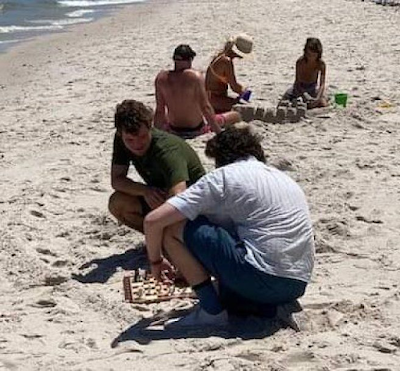
Something else happened that might have been pertinent in the lead-up. The major online chess site chess.com offered Play Magnus Group to join them. The Champions Chess Tour event was followed by a classical chess event, the Sinquefield Cup, in St Louis. Hans wasn't meant to be playing but the last minute withdrawal of another top player allowed him to join. According to Magnus's later statements, he considered withdrawing himself when he heard Hans was going to be playing because he had come into the knowledge that Hans had cheated. It is unclear when and how he learned this - clearly they were on friendly terms in August and by September there was a change.

At the start of the Sinquefield Cup, Magnus's concerns were mainly his private thoughts. Both Hans and Carlsen started the tournament very well, both drawing one and winning one. In Round 3, they played each other, for the first time in the classical format again with black (the less favoured pieces) and Hans completely outplayed him. The next day, Magnus tweeted that he was withdrawing and included a meme indicating that he couldn't state his reason why, with an allusion to cheating. This set the controversy ablaze.. Many people said that he was a sore loser but Magnus had never withdrawn from a tournament before and had been upset by junior players previously without making an issue of it. During the tournament the speculation put huge pressure on Hans, who was now under the microscope  but spoke very coherently in his defence of himself but often poorly to explain his own play. After each game, commentators would usually ask the winners their thinking in different positions and in these Hans often couldn't. Some took this as a slip: that he was using technology and hadn't had to really understand the positions he was in. During his statements, he admitted publicly about two incidents of cheating online, explaining them as his desire to play against better opposition but that he has never cheated over the board (OTB). 

Cheating in chess is an interesting thing to conceptualise. It is very easy to cheat in online chess - in fact, during my play online I'm often compensated back points when one of my previous opponents are found to have cheated and have now been banned. A cheater would do it by having a "chess engine", the most famous of which is called Stockfish, which is now far superior to humans at chess and can almost instantly evaluate a position.. OTB, it is also possible. The longer time controls do give people time to potentially leave the board to use a device secretly. Also, in normal tournaments there are spectators allowed. Even if players are not allowed to have devices, spectators won't be checked and a confederate might be able to communicate or signal in some fashion. The content of communication could be as simple as a stone age grunt to indicate a key position was on the board, to the technological option of a mini audio ear piece where actual moves are sent.

So the Sinquefield Cup was suddenly in turmoil with the champion leaving and suspicions around the player who was now the sole leader of the tournament. Organisers reacted theatrically giving security airport style security wands used on all players coming in, which was now part of the coverage. The Cup had also been streamed live, but after Carlsen's withdrawal, the live feed was delayed 15 minutes before going online to remove the chances of a confederate watching and sending the best moves. 

Whether it be from the stress of the accusations or, plausibly, due to the inability to cheat, Hans faded in the event, but not without some rather odd press conferences. The issue divided the chess community, those who trusted Carlsen's insinuations and those that believed that no evidence had really been shown that in this tournament Hans had cheated. The crisis continued though in another tournament which started straight after with both Carlsen and Hans billed well in advance. There was a lot of expectation about what would happen when they were paired. What arose was just three moves - two by Hans, one by Magnus, before Magnus spontaneously and sensationally resigned. It was a weird decision as it granted his nemesis a point but incredibly, Carlsen still smashed the tournament with a record score. He promised at the end of the tournament to be make a statement and that he did, stating that he believed that Hans demeanour in key positions in his Sinquefield game. And there he made his decision that he'd never play a tournament with Hans competing. He said that cheating is an existential threat that most would rather ignore - he cannot and he would like cheaters to be punished. 

Still, no "solid" proof has been given but the internet has been doing its thing, with people now scrutinising Hans' previous over-the-board games many of which show a high correlation of his moves and engine moves. The proof people want is almost impossible after the fact. Hans clearly hasn't been caught with a device in his hand. A confederate has not had loose lips to say how it happened, either. He is a quirky character so talk about his demeanour might be a red herring, unless he's using his quirks as a smokescreen. That's speculation, too.

There is now an investigation by the FIDE, the international chess body, that will interview both of the players and evaluate the claims. In the meantime, there is a shadow over all games with Hans. For what it's worth, I don't think anyone could say with certainty that he did cheat at this point but I would say it is more likely than not. That is unsatisfying for most and not a useful basis for any action - you can't ban someone without certainty. I just hope that the investigation can have some of the claims truly tested. 

Either way, with a simplification of my work, I'm looking to play over the board myself at the Auckland Chess Centre from November this year. Can't wait!

Sunday, August 14, 2022

A matter of taste

Fictional recreation of a topical event: With the pandemic hitting a school's staffing, a relief teacher is brought in to teach a class of year ten students. It turns out to be a hard gig and some students are not responding to his instructions and displaying insolence, two particular ones are at the back listening to music sharing a pair of earbuds and are drumming away on their desks. It becomes an unbearable focus of his attention and he cannot keep teaching the few keen students with the distraction. He brings it to a confrontation asking for the phone and when this request is ignored. He reaches toward the students, grabs the cord for the earbuds and yanks, removing them from their ears. A verbal altercation ensues. 

Any teacher can imagine this, and most can fantasize the act of "taking the law into their own hands" in the face of students who just don't care and don't mind letting you know it. In the case this is based on, the 72 year old reliever was disciplined, and fought in the Teachers Disciplinary Tribunal to clear his name, and failed. This triggers a mini-tussle of the liberal/conservative culture war in the New Zealand media. 

The case passed me by at the time and it was only related to me by an ex-teacher  in Hamilton who was angry about the whole thing and after his tip, I noticed many more references to it on Twitter. On the way back to Auckland I listened to Jonathan Haidt's The Righteous Mind, and it is a rather good lens to look at people's attitudes to the case.

Haidt is a social psychologist whose name had been mentioned often in the podcasts and books, so I audioread my way through Happiness Theory (also good) but The Righteous Mind raised the idea of moral tastebuds. His TEDtalk is a good overview: Jonathan Haidt: The moral roots of liberals and conservatives | TED Talk. My understanding is that research into moral rules across all the world cultures could be grouped into five different focusses: care/harm, fairness/cheating, group loyalty and betrayal, authority and subversion, sanctity and degradation. He relates them to tastes because just like the cuisines of the world which use or emphasise certain tastes (sweet, sour, bitter, salty, umami) to different degrees, so do different societies and groups have moral systems which sometimes weigh certain areas more. The five moral tastes he suggests is not rooted in the rationalising of philosophy, but quite likely to be linked to human evolution.

Where this gets interesting and relevant is when he, as a self-identifying liberal, notes that normal liberal values focus heavily on care/harm, fairness/cheating, but barely consider the other three which are present in most moral codes from all around the world. He attributes this to enlightenment thinkers such as John Stuart Mill who focus on liberty and equality. Objective sanctity didn't have a place in a secular society; "authority" too especially in modern times has taken a bit of a beating, subversion being encouraged in many realms or a place seen in it to challenge authority; group loyalty was also not a priority because there was primacy of the individual.

Conservatives, he points out, are much more similar to most other societies in history. Authority, whether it be the patriarch, the president, the church leader or the general is important; groups are important. And there are things that should be collectively sacred, like marriage, virginity, the family, religion and sometimes pure ethnic blood. Not only are sanctity and authority features but they also are often more important in a conservative moral setting. Sanctity of the fetus trumps the unfairness on women who have an unintended conception. Authority is more important than harm and fairness - you can rally around a church leader even when they have wreaked the lives of some of their congregants.  

Which brings us back to those cursed headphones. From my liberal point of view, I can feel the violation of someone else forcefully stripping something from me. Teacher or not, you shouldn't be able to do this. A conservative also rightfully feels the moral outrage and the gross unfairness of an authority figure disrespected, who acted against those who were subverting his authority, and whom the authorities punished. 

The point is not that conservatives have a superior system for having all the moral flavours - most conservative values like the above don't work for diverse societies. (Feel free to argue they don't even work well in homogenous societies.) But his greater point is not to demonise or to think the other side is intellectually challenged. You might as well argue about whether it is acceptable not to like tomatoes, that apple pie is the supreme dessert or that minor controversy of pineapple on pizza.

Monday, July 04, 2022

An empathic clash

Note: The thoughts below are from a male. So please forgive me should I not be staying in my own lane. 

In the last week, the US Supreme Court overturned the precedent Roe versus Wade, and somehow the shockwaves washed up in New Zealand with political insinuations and media froth on an issue that was not meant to be an issue here. (Let's just hope that there is no inspiration for such an issue to have any currency.) But at the crux of this and all the other issues are the entrenched camps with a distracting proxy war of ideas and a distinct lack of empathy.

I say proxy because it always seems like the sides just marshal the ideas or rationalisations that they're partial to and use them to dress up their respective positions. But at the heart of it is a lot of emotion. It's easy to say "Facts don't care about your feelings" but the incidental point felt is always "My facts don't care about your feelings" and the converse that another's facts won't change my feelings. And there is history, both personal and social, that sets these things up for context for the feelings that are at the heart, as if talking about where a convulsion of cells is declared a fetal heartbeat and define the be-all-and-end-all of this. The facts can fight - and I am easily lured into the quest for an answer or a fact-based rationalisation for my own intuitions and beliefs but at the end the true edges of the conflict are usually emotional.

You have the emotions of actual people for whom it has been worked into a item of moral and tribal faith, that a conceived human organism has personhood and their deliberate termination is equivalent to murder, and who would not object to the permissible homicide. I do not consider such people arguing in bad faith though there are probably some who use it cynically as a wedge issue. It is understandable that they have a passion to stop the practice, just as there was to abolish slavery, even if the "easy-fix" of  banning this medical procedure has easily identified unintended consequences and obvious inequities that are not even on the agenda to be remedied in the States.

Then you have the actual body of people for whom a change of state law would potentially affect, namely fertile women. The "rationalisations" against them are the brutally simplistic: If you don't want to murder don't have sex unless you want a baby, as if it were only the woman responsible for an unintended conception and, worse, that abortion was the primary, and preferred, method of birth-control of women, that the chance of pregnancy was not a constant female anxiety in any heterosexual relationship and even worse, not potentially not consented sexual intercourse.

There is no perfect solution in these situations, and it is even more remote with the "I win/you lose" mentality and the demonisation of the other. In a civil society there is the requirement to draw a line somewhere and it will in its drawing disenfranchise some people. There is never much empathy in these clashes and not much pragmatism. If those in New Zealand who abhor abortion were understood the same as those that abhorred slavery on moral grounds, they appear more human. Not that the motivations of anti-abortionists are necessarily just a moral one, and there do seem well and truly other purity issues and the desire to suppress "fornication" and go back to that wholesome world we had before. 

Part of the empathy lies in the historical and cultural legacy of the past. Women, though more equal than the past, still experience latent and implicit sexism, may have moments of terror at the deviantly sexual menace of a stranger or acquaintance. Meanwhile the conservative, Christian position is that of the once-dominant culture that has been eroded and feels a perpetual sense of loss, even if they never knew how good they had it.

In the US it's always more of a circus mirror because the evangelical instinct is to not just to ban abortion but to mandate abstinence education over sinful contraception. Unlike New Zealand, they seem to legislate on puritanical instinct rather than by select committee so the individual states seem to develop biblically inspired from-conception standards, and not understand at all the range of possible pregnancies that could occur. The number of weeks of pregnancy is not from the moment of conception but from last period so if conception occurred in the third week of a woman's cycle they are already three weeks pregnant at fertilisation. Six weeks pregnant, a standard adopted by Texas, is literally only two weeks after a missed period, and even that might have had some bleeding. Miss that and you either may have a baby or an illegal abortion. 

Another example is the rending of people is the trans-rights debate. There are a range of camps from the the trans, the "woke" (basically people who accept that transpeople exist and there should be changes); the TERFs (so-called trans-exclusive radical feminists, people who feel that transpeople are a threat to biological women); the gender-conservatives (often those who try to have puberty blockers and any transition treatments illegal until someone is an adult) and maybe a swathe of people you could just say are wryly indifferent to the whole thing but could accidentally say the wrong thing to the wrong person and feel victimised for discriminating.

The proxy war of ideas is again a ridiculous mess of whether the gender dysphoria actually exists, arguments about the rate of transition regret (where someone realises they weren't transsexual after all and want to stop transitioning), testosterone levels in transgender athletes and hypothetical situations where a man should be able to walk into any female changing room saying "I identify as a woman".

The most fundamental empathy at the heart of this is someone experiencing gender dysphoria. Even in these more enlightened times, people are pretty instinctively man/woman equivalent to male/female. Once someone is openly trans, they will often be supported but between those first realisations and being confidently out must be extraordinarily difficult and emotionally straining. Also, any inclinations to show your real self in the presence of less enlightened individuals opens you up to either innocent or malicious hurt. 

TERF meanwhile seems a jarring and even unfair name to a class of mainly women who want women to be women and not want transmen to be part of their category. This might seem cruel to a persecuted category but biological women have not had any kind of gender ascendancy, and without any pragmatism, it seems they could be left to make all the accommodations just like they would for the return of abortion-bans in the US. (It reminds me of how Frederick Douglass broke with the female suffragettes after the abolition of slavery as both the once subservient and the still submissive competed for the right to vote. Douglass felt the liberated and free blacks had a more pressing need for the vote because it was a matter of survival, whereas he viewed female suffrage as inevitable but a want rather than a need. The suffragettes of the time felt differently and that they should not wait.)

The gender-conservatives might just be same abortion obsessed stuck-in-the-muds although this is about empathy, I'm not going to spend any more typing on them. The wryly indifferent, however, are deserving of some expansive empathy. They probably would be sympathetic if a transperson entered their lives but has not had reason to really think this is real issue, but also with the time to adapt to this rapid change. I saw an unusual eruption of frustration last week from one because he felt he could never say anything on the topic for fear of saying the wrong thing and losing his job. (You could ask why he would need to be saying something but that is also the wrong question to ask.)  

Empathy doesn't in itself solve any of these great dividing issues. But it is only with empathy that some pragmatism and middleground could be imagined. Though I don't particularly like him, the treatment of Luxon by the media was rather ridiculous: he voted against the legalisation of abortion on a conscience vote and was forced to say in a hundred different ways that there would be no review or change to that should National win the next election. He is free to have his beliefs and there should not be any sense of disqualification from running by holding conscience views contrary to the mainstream. What he did say was that he really felt for women in the horrible situation of needing one, and though he is hopefully past the possible need to even consider that decision, I would hope that he would not be a hypocritical and would have the view guide his personal conduct.

My only relevant reference point of someone who could have had an abortion are our friends, who due to their religious views, chose to continue a pregnancy with a fetus that was detected to have many issues including Downs Syndrome. Apparently they were offered the option of termination on more than one occasion which offended them. The young 'un is now three but reading the snapshots of their challenges with him would test anyone in their view. They are still strong in their faith and requesting and getting the prayers of a wide range of friends, and boy do they need them. You can only feel for them.

Tuesday, June 14, 2022

Frederick Douglass

The very human feeling of compulsion towards something that you fancy is lovely when you are not in its thrall. I remember when we had a rat (or two) in the Marsden Ave apartment and used peanut butter as a lure for our traps. It worked like a charm and the reward was the disgusting removal of a feral corpse. If aliens want to trap me they'd just have to put a jar of almond butter mixed with honey and basically all fear would go out the window and my fate would be experimentation out of the world. 

Books, when they are a compulsion, is a quaint idea. We can imagine easily the compulsion of food and drink, sex, and computer games but books can captivate. Audiobooks, too, it seems. If I could say that I dread the weeks when I don't need to commute to Hamilton it might surprise. Why? Because I have an excuse to listen to my books. Recently it has been the Asia Saga from James Clavell some of whose books go into 50 hours which no normal busy person could finish in four weeks without a strict regiment. Right now it is a biography about Frederick Douglass whose 40 hours I still need to work hard to complete.

I didn't know anything about Douglass until a few years ago when President Trump described him as "an example of someone who’s done an amazing job and is being recognized more and more" which betrayed the Don as it made it obvious he though being someone who can speak with full confidence and bluster about someone or something that he knows nothing about Frederick Douglass. The grammarian will notice that Don was using the present perfect tense with a person who died in 1895. Don may have thought one day that he'd have to give Frederick the Medal of Freedom. But Frederick Douglass did do an amazing job. I am not half-way though and I'm already convinced of that.

He was a slave for 20 years until he escaped but emerged not only as a charismatic speaker but one with clear principles, the power of literacy much beyond those who had spent their youth in education and the wisdom for the ages. In this modern age we know the population-scale effects of deprivation and discrimination on a group while also observing those few sparkling lights of the extraordinary who stay strong and not be cut down as they distinguish themselves where most others would fall. His spectacular emergence was an antidote to that of age racism - a slave who was or became a gentleman and a scholar. Or should have been the antidote but for the dogmatism of white superiority, or that the real politick realised that emancipation of the slaves would devastate southern states regardless of moral questions. Any realistic person could say that slavery as an institution and racial notions are not of an objective rational mind. But what we can say about the blinkered prejudiced minds of the past, it is also pleasant to hear the lives of the anti-abolitionists of the times. Some people really were passionate in their support and desire to subvert slavery system, hiding slaves, supporting their escape to British colonies. While the politics of any moment in the past is hard to grasp in the competing persons and policies, that time in America, the emergence of the Republican Party and their very first elected US president, Abraham Lincoln, was part of the tumult of the times. 

So here is to compulsions of learning of lives. I will blog about the Asia Saga once I can listen to the final 50 hour novel and complete the full view. 

Monday, June 06, 2022

The Project of Rehumanisation

Names are funny little beasts. I remember a time in my youth when I assumed names actually imbue the person with a characteristic. If I met someone with the same name as any of my childhood peers, I would expect someone similar. Kanes are bad boys. Davids are honest and shy. Tims are a bit rough. Natalies are tomboyish, and so on. It is not a surprise that this phase didn't last and I even got to meet some Daniels who were rather undeniably unDaniel. Such are those strange assumptions and realisations of growing up, even thinking that something as shallow as names or words could be definitive of the person, rather than a living vital person be defining, and filling the name. But there are examples galore where people, either with words or narratives, define the others. 

If I could draw a very amateurish theory, I'd say there is an uneasy relationship in our minds between language and real things in our minds, language is such a convenient shortcut to dealing with things, but are inarticulate when applied to people. When we observe something about a person or thing that goes against a label, there is a dissonance and we feel a greater faithfulness to the label rather than what we see with our own eyes. The language or narrative we put on people, though adaptive in these complicated times, seems to butcher the rich four dimensional reality of someone. 

One of the crudest skills of the bully is to take someone's name and bend it into something worse. Trump was masterful in having the media repeat his nicknames for his rivals and enemies, and have his followers and mouthpieces repeat them: Crooked Hillary; Low Energy Jeb; Crazy Nancy. He did it with mini-narratives that are accessed through labels such as Hillary's e-mails or Hunter Biden's laptop. In New Zealand we have had a spate of this with the variety of names our Prime Minister is referred by her detractors ("Jabcinda"). And the function of name-calling is that others will have a caricatured image that others can see despite what they might see or know. It also sets up for confirmation biases, or give reason for partisans to create narratives around them to reinforce them.

Racial stereotyping or gendered thinking is a more garden variety of this. This is nothing new - we shouldn't judge a book by its cover and experiencing a broad range of any category of people will usually show diversity. The quote that was profound on me ages ago that I'm glad to have been able to track down: "There is more genetic variation within self-identified racial groups than between them." (Professor Audrey Smedley) Living abroad helps when you know that there are quiet "Americans", arrogant outspoken "British" without any sign of a tight upper lip; you'll find numerically challenged "Chinese", and some not so inscrutable "Japanese". It's not just for race and gender but for any what that replaces our idea of knowing the who.

People also have the strange ability to equate a person with a single act from the opus of their lives, or take an utterance to be their a saying representative of their soul and being. To be clear, there could be plenty of heinous acts which in their very doing do tell you something significant about who a person is (although nothing even remotely close to their totality). However, there are plenty of poor choices, as well as occasions of poor execution made by people that may somehow singularly transform how they may be seen... even when we do not have the context for what was said or done, or even worse, we rely on someone else to tell us what was said or done, and despite their lifetime of saying and doing all sorts. If I were to insert a thematic segue to my previous post, people who have been "cancelled" may feel this the most. As individuals we can feel for a while that one mistake or something poorly said is our everything, that we could creep into a hole and die, at least for a while, and it doesn't help when the world seems to agree, at least for a while. 

To me, these things are all kinds of dehumanisation, where someone holds a caricature in their mind of others, even despite evidence to the contrary, which robs them of their dignity and uniqueness. Holding such a shallow representation is adaptive to the observer because it is consistent and does not require too much extra mental processing and adaptation to differences in people. Stereotypes after all are a kind of a heuristic and means we can make practical decisions quickly. But inside every Tamati, Dietrich and Hashimoto is a beating heart, who has beat through a childhood, maybe with a mother that loves them, and making mistakes, longing and learning. They have a body with marks from scraps and sickness, of predisposition, of summertime outside. That is a full person and to recognise the space to know someone. And that would be what I would say is to rehumanise someone in our minds.

Besides the banal not judging a book by its cover, there are other rehumanising practices, such as "be kind - you will never know the battle others are fighting". Another one is the awareness that we often attribute our own failings to circumstance, and the failings of others to their character, and that we should always look to see others failings in the context of circumstances. Or meditating on the basic physicality of others and ourselves.

Probably the interesting part of my job has been to be more and more aware of the cultural norms around introductions. I'm typically all business when it comes to my intros but have tried to broaden them out because in Pacific and Māori cultures, introductions are important - they should be more personal and they should be paid attention to. With students of that background, unless I want to be dehumanised to a short, bald white guy, I should show some feelings, values, habits, hobbies and origin rather than just my role and responsibilities. I remember shortly after returning having a tikanga training and having the facilitator first ask us to introduce ourselves without any prompting, to which we gave various depths of responses, after each of the intros she would ask a deeper question, or to note something in common, which she later said was a function of the habit of introductions. People do have a desire to know with whom they are working with and commonality builds trust, and it shouldn't be replaced just with a handshake. There are situations where we do not naturally have introductions but where small-talk allows some way to fill in the backstory of someone to get over the labels and assumptions that we might have. And there is a delight in speaking with a real person.

Those are easier because a new person is a new page. It is harder to rehumanise people you have known for some time and for whom their are bygones, mutually spent time but not with mutual discovery. Some of my colleagues fall into this category. They are caricatures to an extent: I know their working persona, their good and bad deeds either first or second hand; they tend to know me the same way. It could be easier to lump the Indian females into a common person, the males into another. The Sāmoan women who speak English as a second language, and for whom English has a certain tone and articulateness, which makes them sound ignorant or lowly educated, even if they have a doctorate, and that does all of them harm, even if they do not have a doctorate.

Our ways of interacting with people can often be culture-bound, and that to adopt another cultural mindset can help overcome the power of shallow impressions. One word from te reo Māori that is useful to know is tapu, which is often translated as "sacred" or "restricted". Everything and everybody has a degree of tapu, and it has to be reduced by becoming familiar (whakanoa) if you are going to be in contact or conducting interactions with another. Another word from te reo that has had quite some currency in teaching these days is "mana-enhancing" (whakamana), describing to a mode of education that ensures the dignity of people in the education process, that we are building people rather than sorting them out into elite, the also-rans and the failures. Whakamana though is to recognise the dignity and integrity, the inherent and accumulated mana of someone else. When you see all others as tapu and having mana as part of the framework to your world, they are humanised or rehumanised and you will have the humility to let them be themselves.

No matter how you do it, I think there is value in indulging in a project of rehumanisation of others in your life, especially with the people who are often in your life, but also for those that are very familiar and may have be incidentally dehumanised by a label or an event and have been incidentally harmed. I could talk about how we can rehumanise ourselves who we harm with labels and narratives but that can wait till another time.  


Friday, April 15, 2022

A Not-So-Short History of Cancellation

The topic of the so-called cancel culture trend is apparently at a crescendo in various pockets of the US media especially with the sickening tendency to align it with political partisanship, and bad faith arguments rather than any substantial discussion of what is at its heart. However, the term has no lack of currency in New Zealand. You can read tweets from Pākehā men afraid to be cancelled because they can't say te reo Māori names correctly. Meanwhile there has been a kerfuffle in Māori twitter whether tangata whenua can use the N word. Without a heavy reading of all that others have opined, I would like to say my own not-so-hot take of this rather lazy catch-all term of "cancellation".

I recall back to the staff Christmas party of 2020 when I was talking to a Chinese colleague about the song that was playing from the organiser's playlist, a Michael Jackson song, which for the life of me I cannot remember which. A member of the organising committee listened in and once I turned to them they had mentioned that it was a huge discussion about MJ and whether to include him. It was only at that prompting that I did remember that people do talk about whether to "cancel" a person's body of work and legacy, which in its most extreme conceptions we collectively stop playing his songs, remove his songs from sale, remove his winning of awards, deny his cultural significance and stop doing the moonwalk for the likely true allegations that he molested children. (Actually more extreme is the Stalineque removal of someone from all photos as well, I guess.) Or on the other hand can we just acknowledge the allegations but separate the man from his art? Back in 2009 at the time of his passing, I was about to head of overseas, and did not note my thoughts at the time but I think my view was more for the latter - let his name be associated for what he did both good or bad, as a human, but let his art live on as one of the positive things he did. Back then there was no "cancel culture" just "political correctness" idiomatically running amok. 

Since then though #MeToo (Crypticity's abound: A touchy subject) and the arrival of things labelled as "cancellation" have begun a thing. I generally believe it is widely misused term because what is cancellation in what it would be in the extreme case of MJ, is not what is happening for most people. It is just criticism for unfavoured views. For an exploration of where the term emerged from and how it manifests itself now, On The Media podcast did a great investigation: 

The general opinion aligns with mine. I would go further that if we retrospectively apply the cancel culture concept into the past, it is easy to think of lots of examples of the overwhelming cancellation of people, ideas and culture. Those that feel now experiencing social consequences for mocking Nanaia Mahuta's moko kauae do not think about the long term consequences experienced by those with moko of various forms until very recently. You can imagine a conservative of twenty years ago saying that if someone wanted a job they should have never had a moko tattooed, because who would employ them? If people experience social approbrium (AKA cancellation) after criticising homosexuality for religious reasons, they might realise that there was no freedom to express one's homosexuality in public until recent decades, and even when it wasn't illegal, it still faces social consequences in some contexts. And if those who voted to keep conversion therapy experience criticism and feel like they are experiencing cancellation now, they can read about how Alan Turing, the genius who cracked the German Enigma code in WW2 and was key to the development of computers, was cancelled for his homosexuality and then crippled by conversion therapy before taking his life.

The New Zealand based voices that there is a cancel culture in New Zealand academia are interesting to look at: Academics Divided On Their Own Freedoms | Newsroom. The low number of respondents  who felt free to discuss issues relating to te Tiriti and gender issues is a concern, the former perhaps a result of the furore caused by two prominent professors saying that mātauranga Māori was not science (Crypticity's abound: Whaowhia te kete mātauranga - Fill your baskets of knowledge). The latter issue of gender and sex issues has become quite politicised, especially around the rights around transition treatments, transpeople in sport and equitable access to facilities and its presentation in public education. It makes sense that anything where there is high political tension that there is less freedom to speak. Only the fool-hardy or the hard-headed charge out of the trenches in a culture war, let alone peek over the parapet from an ivory tower. 

On both te Tiriti and gender issues, there is a reluctance on the part of "the cancelled" to consider changing views that, I would dare to presume, are unchanged from the early formation of their ideas on those topics. And there is a lack of willingness to engage with how to think about this beyond their own assumptions. And those who are aggrieved when authorative figures again state the dogma around te Tiriti or gender issues tend to respond in a way that does not offer paths to any form of learning or redemption, but rather doubling down and digging heels in, which serves no-one.

Some of their concerns you could reconcile easily with the Americanism: You can have freedom of speech, but not freedom of consequence, something I talked about and still agree with after the Charlie Hebdo massacre in France after cartoonists drew the Prophet Mohammed (Crypticity's abound: Get outta the house!). You can have a view and voice it but private individuals, the groups you are a member to or the authorities that oversee your professional or public life may provide some form of consequence against you. But these tend to be nothing compared to the unrecognised cancelled of the past. People might criticise you for supporting Russia's right to militarily engage with Ukraine but what happens is nothing compared to what pacifists were exposed to in the past. The anecdotal cases of people losing jobs for tweets or Facebook posts for their views on race, gender, etc. are nothing compared to the legions of people who have lost opportunities for jobs for having a race or gender. 

Back to the MJ episode, which is a truer question of to cancel or not to cancel, I'm not sure my mind is changed, but watching the Netflix documentary on Jimmy Savile is surely the greatest food for thought, because by the end you'd like the BBC to destroy every video ever made with him in it. Frankly put, past Jimmy Savile content can barely be watched without recalling what he was doing at the time off camera. His whole body of work and especially his philanthropy seemed not just a way for him to perform some form of moral licensing to harm others, but was also a method to indulge in more molestation. While the editing of select moments from a lot of footage makes it look like he was doing it in broad daylight, you wonder whether it was that apparent to a producer, let alone a member of the public it all was. Since his death came too soon, and the authorities and media acted too late, I would say that his name living in infamy and some restitution for those affected is in order. He was a manipulator so while I wouldn't say the Monarchy, his professional collaborators nor other high profile friends should bear much scorn for their association, the police and BBC should have had more consequences for their part in delaying and protecting. 

Anyway. There has been over two months here without a blog, which in my whole blogging life is a chasm. The last blog was in early February which unsurprisingly came just before my formal appointment as a Head of School, while my previous position of Director of Studies was still being recruited for. Over two months on the position is yet to be filled, I have had to caretake that previous position while also adapt and craft the new one, which has been very challenging as both positions were only getting more heavy and complicated. That explains my lack of blogging to an extent, and a lack of push to get my Achilles right and have me back running. 

Saturday, February 19, 2022

Manning up to the mandates

It's been 12 days since an organised protest movement of diverse origins descended in front of the New Zealand government buildings. It's been an interestingly unprecedented time.

Previously I have discussed about the mandates and my view that in a pandemic the social contract for mutual protection justifies it to encourage and, in particular fields, compel those whose risks and benefits of vaccination are modest in order to do something that for the whole of society is a good thing. There are plenty of similar cases: taxation, rules around alcohol and tobacco, road safety and dare it be more analogous, compulsory childhood vaccinations. Vaccinations though are quite an invasive kind of obligation to put on someone. A bit like fluoridation of the water, or the fortification of staple foods with supplements, it takes away a large degree of choice about what you put in your body.

I feel that the New Zealand case easily justifies it with our "Delta wave" crushed without the mortality and morbidity inflicted on other countries; in fact, it is hard to find any country which got through a genuine wave with only a mere extra five deaths per million population added to the pandemic toll. Our effective booster campaign might also curb Omicron, time will tell. 

In terms of the risks from the widespread vaccination, there has not been a rise in excess mortality in NZ in either 2020 or 2021, nor an unexpected rise during the peak of the vaccination campaign, literally no "signals" from the data. At this time there are only two confirmed deaths linked directly to vaccinations; while there is undoubtedly a number of those who have had bad reactions, an unblunted Delta wave would have easily caused more harm.

A poll instigated by Family First has shown that New Zealanders may have less fondness toward the mandates now than they had last year when they were introduced. But there was an interesting finding amongst it: "1 in 3 vaccinated Kiwis said that the vaccine mandate or pass requirements were a large factor in their decision to get vaccinated." For the vaccine or mandate averse, this is a negative - a sign that people were compelled, but for me it is the opposite: If we had a third fewer people vaccinated, we would have a rate similar to what has happened in many European countries, Israel and the US. 

It has been often pointed out that under Omicron, the mandates themselves offer only marginally more protection to the vulnerable as life without the mandates. Omicron appears to more easily evade the immunity gained from vaccines (as well as previous infection) and triple vaccinated people can catch and pass it on to an unfortunately high degree. Thus there are people asking whether the mandates are the right tool. In New Zealand, especially until this wave has subsided, I would say it is still a reasonable tool. Freshly vaccinated people have broader, less evaded immunity and any encouragement to have this happen is still relevant. 

The vaccinated are also less likely to end up in hospital. Like it or not, the unvaccinated who are the most at risk have been excluded from a lot of places. (An outdoor protest is ironically a pretty safe place to be, much better than a workplace.) With the desire to avoid overwhelming the hospitals, it seems prudent to have measures that slow down the rate of growth of the Omicron outbreak. 

The response of the anti-mandate people has been unsympathetically seen as pākehā people who have never been discriminated against reacting with their white privilege. There might be a trace of that in some but you have to admit that if you had made a decision to not get vaccinated, the implications if you are in a healthcare or education, or in the emergency services, it is a hugely disruptive imposition to one's working life. (To be clear, the decision to close the border effectively did the same thing to many jobs.) For the people in other fields who are not vaccinated, or who do not get fully vaccinated for reasons of a bad reaction that somehow doesn't meet the rigid criteria for an exemption, life is a real headache. It is a pause on any life at cafes and restaurants, even outdoor events may impose vaccine pass requirements, and your job could still be affected. (On Thursday, a staff member failed to check a vaccine pass for a tradesman and got into trouble for allowing an unvaccinated contractor on campus. Not the first time a contractor, a comparatively free form of employment has evaded checking that I know about, but clearly they are trying to continue their lives despite private businesses who may require them imposing the restrictions themselves.) But this is not intended to be permanent and once they do not serve a purpose the mandates will end, thus spake the Prime Minister.

It is hard to see an end to the protests. It is easy to advocate "clearing them away" but this is heavy-handed and at worst setting light to a powder keg. These people have nowhere else to be right now: no job; there is clearly funding, food and resources either from the sympathetic public or by externally interested parties. I would look to a way to negotiate with several parties who have a clear and large membership of people behind them for the intermediate goal of removing vehicles and even a small win for vaccine-adverse. 

Even though I support mandates, an increased vaccination rate has already been met, and if I were negotiating I would be open to loosening some of the rules in spite of the rising number of Omicron cases. But the lack of cohesive leadership in the protest movement, or even a negotiable list of demands, apart from complete governmental abdication of a fairly understandable position, is really an issue. Unless the protests are for a purely political purpose, there might be no way out except for attrition, and I would have recommended some initial "attritional" steps. Currently, with food and basic services being provided the protestors have no reason to leave. The first step would be to ticket cars, and then state that ticketed vehicles would be towed. That way there would be some "skin in the game" for protestors to decide whether to stay or not, and a reason to accept conditions.

As good faith I would immediately relax rules around the unvaccinated eating and enjoying outdoor venues. This would mean legal protection to say eateries could not enforce vaccine pass requirements for outdoor areas. Any outdoor recreational event also cannot apply vaccine requirements. 

Though the quoted survey suggested that the public would support daily testing of the unvaccinated to retain employment, it is somewhat of a red herring. There isn't the supply to allow this except if it was funded by the unvaccinated people or companies themselves for their unvaccinated staff members. If I were a company whose function was impacted by the mandates, I would have sought to have dispensation to support the testing of key unvaccinated staff, but the wholesale testing of all unvaccinated would be difficult and could not be publicly funded. Even with a factory on our shores, the requirement for hundreds of thousands of rapid tests and PCR tests daily on top of what is already required to service public health needs is not feasible. But with the compliance requirements on the companies and the requirement to have everyone mask, I don't see a downside to some industries, especially with key staff to have this allowance.

Now that we are mostly vaccinated, and the militant antivaxx medical practitioners have been sidelined, it would be a positive step to allow GPs the power to make prudent exemption decisions freeing up those who cannot get double vaccinated due to adverse reactions on their first vaccination to take a greater part in society.  

These would be my requirements if I were negotiating, and it would be done with the additional pressure that those with vehicles would soon have their vehicles fined and prone to being pulled over at a later date for unpaid fines. And with the additional issue that eventually, the vehicles would be towed.

It is a pity that anti-mandate sentiment often coincides with anti-mask animus. If staff in the mandated fields committed to wear a provided N95 or similar facial protection, I would, if in power, suggest this as an appropriate loosening, that with the provision, either publicly or privately, of a high quality mask, unvaccinated staff should be able to keep working. However, it would rely on the integrity of those who, even in the protest situation, are not demonstrating the expected consciousness of their potential infectiousness. Even as a triple vaccinated person, I'm masking and it disturbs me that people in these roles do not have the awareness of others required for the position. I believe those in hospitality, such as baristas and the like, with clear supervision would wear a high quality mask. The industry is need of work so I could see companies willing to cough up and extra $2 a day to make sure they have good staff. 

When members of the protest have a better situation to leave for, they have a reason to be elsewhere, and I would hope that the above weaken the resolve of the majority to waste time when income could be gained, a step towards a reintegration with common society could be imagined, which would happen once the Omicron wave has ebbed. 

Part of my job over the last couple of weeks has been to handle outbreaks, creating a process for notification so that staff can have certainty of what to do, sending classes home into self-isolation, creating a path back to leave self-isolation and back to the classroom etc. At the same time, our organisation has been doing the same with staff as we did have our own outbreak. For all the discussion of how "useless" masks are, two of three positive cases were probably the least diligent with masking. I was a casual contact with a staff case and now two student cases, but I use an KN95 mask, which while not impervious does give me far more assurance. Even with the mask, I still got tested after the first student case (unbeknownst to be it also followed the casual contact with a positive staff member - I only found out a few days later).

I was asked how I was coping with all this, and to be clear, I'm fine with handling pandemics now. The arrangements are pretty easy. I believe I was pretty clear since March 2020. The details may have changed but the best practice of effective communication and clear processes are still the same. One of my previous posts was called Stalemate because my role was changing in a direction I liked but in a manner I thought senseless. I baulked. Despite my objections, my role has senselessly gone in the direction that I liked but without a single change in the mode. Now, on top of handling the Omicron outbreak, I'm doing two jobs and even once my old job is resolved, I'm still marginalised in a way I don't like. When it was decided that things would proceed as was planned without consideration to my situation, I said simply, to do so would risk a lot and if the group was prepared to take the risk, then it needs to realise the risk. It cannot eat the cake and have it as well. But there was no change - it committed me to a situation that I may not want to stay. There was either a rigidity of thought that things couldn't be another way, or just a desire to marginalise me. Either way, it is an inhumane approach. 

Whether it is from mandate or otherwise, it is not a great feeling to have your mana and rights seemingly infringed from without. The wisdom is to take it for a moment to buy you the time to act. The protests may result in a change of government in 2023. My change in role may break me away from my employment of 6 years. Only time will tell.