Being back in New Zealand teaching English is quite different from teaching abroad. The environment is a big part of that: New Zealand is a much more regulated teaching environment; there is even more competition; and it's an export market restricted by immigration and currency fluctuations. But the thing that I've noticed most is the difference in people.
I'll start with the students themselves. Students in my school in China were adults, most of whom had made the conscious decision to learn English, were motivated by the idea of learning another skill and had a degree of buy-in to how we taught. The school focussed heavily on English for life and communication, so that students could socialise, travel and work with foreigners. Even the occasional young or immature students were a minority so most had to temporarily "grow up" to the maturity level of the group while there. In New Zealand, however, language schools don't generally have the same focus. The emphasis is on English for Academic Purposes, which prepares and qualifies students for mainstream study at training institutions, polytechnics and universities. The result of this is that the Chinese students who come are even younger than those taught in China, usually between the ages of 17-22 years old, and they form a majority or a sizeable part of the whole student body.
Some common phenomena of this age-group in China children is a complete lack of any sense of self-determinism, a lack of ability to self-regulate and an inability to respond to the reality of consequences. Their lives have been controlled and planned from an early age. By appearances, their maturity seems a good 4-5 years lower than local students the same age. They by-in-large didn't choose to come to New Zealand. Their future majors were decided by their parents without much buy-in. Of the many I asked about their future study direction almost all began with: "My parents want me to..." Important life choices can't be left to the children, and experience at making life choices, or even day-to-day choices, is pretty low. And most are in a stage of mild rebellion against authority, when their real authority is far away. They are generally "well behaved" though and only rarely have some of the maliciousness that you might see in some NZ teenagers.
They have passive coping mechanisms, too; they will do what needs to be done without being present in mind or body. In China, you are a receptacle for knowledge to be filled by the teacher, which you do without question. They present themselves similarly in English class where unfortunately only actual practice and communication will allow you to progress. There is the slouching. I feel the need to straighten postures, often righting and lifting when required. There is the need to make obvious consequences for lack of homework (it can't be brushed off). Absence must be followed up, or else why come? There is a need to be strict on mobile phone access because if it is allowed there is no self-restraint from social media; 80% of the time phone use is not for the dictionary, and the dictionary isn't going to be helpful for their learning anyway. You get a fair bit of "don't know"ing or other forms of "kicking to touch" in order to avoid venturing guesses or doing cognitive work. They really are just passengers fidgeting in the seat of a journey not of their choosing, young adults living out their teenage years.
Knowing China and Chinese society, you know how this all comes to be. While I was philosophising on all of the above, my wife was a coordinator for a visiting student group of a younger age range, 10-12 years. Worse still, two of them had their parents accompanying. Worse because if you want a young person to experiment, make mistakes and embrace something different, the worst thing you can do is to have a safety blanket and monitor observing. Even worse, one of the parents was a principal of the school group who cannot seem to wear multiple hats. They had the chance to see a local primary school here and how the students were and the contrasts were huge. Lunchtimes, for example, here students are told to sit eating till a bell before they can play and release all that childhood energy running around before another bell signals that they should return to class. In Chinese schools of a similar age, children do the eating part and then return to class. If a Chinese school had a visiting group, it is regimented into a well-practiced performance with only particular classes observed by the visitors and choreographed interactions. Here in one situation the visiting principal randomly requested an explanation and local students quickly volunteered to help her and explained eagerly and easily. She asked my wife later whether the students had previously practiced this explanation in preparation for their visit. How did they know to come up so spontaneously and explain clearly. The answer was obvious: Because that's what they would usually do and do often. The groups also did visits to more touristic destinations. When they had the chance to touch alpacas, all the local tourists jumped off the transport and patted them; but the teachers and parents of the Chinese group told them to stay inside because "it's dirty". The process of growing up over there is usually one of excessive control against risk, which is something that doesn't suit learning. You hear accusation of the latest generation in NZ being molly-coddled. You haven't seen anything till you see it in the Middle Kingdom. And NZ is not a paragon of child-rearing.
So Chinese students here are different to our students in China. They're younger, passive and disengaged. But the teachers have a different situation, too. In China, all teachers were on one year contracts by necessity. Local teachers had two year contracts. These contracts protect teachers coming from so far away at some expense that they will have security. It also protects the schools vulnerable labour supply - planning your supply of teachers is difficult. In New Zealand there is a plentiful labour supply, liberal labour laws and fluctuation in demand. Most schools lock in decent reliable teachers and reduce the less desirables to short term contracts, and this has a huge effect. We've been hiring for quite some time now and 90% of the applicants are floating, often for obvious reasons: accent, attitude, mentality, mental issues, bad-fit, correctable lacks of skills and competencies etc. They often float from school to school and their CVs show their short-term wanderings. They're like itinerant journeymen and women, disposable hired hands, although a little messed up from the constant lack of stability.
A month ago I interviewed the two people who looked pretty decent on paper. (That is actually a bad sign. We've seen too many paper-great; reality-loopy teachers. Boy, are there some cracker over-qualified people out there.) Both were ridiculously hard to get hold of, despite being keen in their cover letters. Once pinned down to come, one barely smiled for the first 10 minutes of the interview, before I finally found a way to build a rapport. He eventually showed enough promise and I called him back to see if he could come in for a demo. He said he was moving house and would call me the following day after work to confirm if he had the time to come in. He didn't call or contact me again. And I had to teach the class.
The other was almost comical: We agreed to interview at 3:30pm. She mentioned she would need to leave by 4:30pm for appointment. I'd told her it was fine. I found her by the reception at 3:10pm and so I approached her:
"You must be Marsha." (not her real name)
"Yes, hi," she said nervously
I introduced myself and said that we normally get new staff to fill in a Application for Employment form. The receptionist wasn't there so I went around to check if I could spot it.
"We might have to wait for Mickey the receptionist to come back."
"I can come back another day," she said.
"Er, no, she'll be back in a moment."
"I have an appointment later."
"And you need to leave at 4:30pm, right? We should have plenty of time. Perhaps have a seat here. I do have some students to speak to now so I'll make sure Mickey gives you the form and I will be back shortly."
When we finally got down talking she seemed to have ants in her pants for the first five minutes. Clearly she didn't like interviews but relaxed later and presented herself better. She was aiming to do the DipTESOL later and she went into the nuances of teaching theory. But I had not confidence that she'd be able to demonstrate those to real people.
Both of them pretty much were lost because they'd presented badly to the HR manager even before the interviews. But we needed staff badly so I met them (the HR manager was on vacation that week.) But they were lost to me upon the first interactions. Both are bad indications in a very short sample time that they might be difficult to handle. I knew from the second halves of the interviews that both however were desperate to get out of their vulnerable work situations they were in at the time. It felt like a kind of self-sabotage that they were unaware of. These are two tales of what comes out of the soup of slightly-less-than-adequate teachers. And regrettably it's the soup that my wife has entered. Her ethnic name puts her in suspicion of similar inadequacies in the same way that it would at our school. (So often interview times are wasted because the person is clearly unable to maintain standard pronunciation. There is also the desire of most schools for marketing purposes to keep to a mostly Caucasian workforce that leads to a not so subtle discrimination. For what it's worth we've employed two teachers of East Asian extract as relievers and a half-Taiwanese ABC as a full-time teacher.) In her first teaching job, she wasn't given a contract. They did pay on time though. This wasn't racism: That's how the other school, a respected language school in Auckland, handled relievers.
So the Itinerants teaching the Passengers, that's what a lot of what's happening in the language schools, it seems. There are of course a lot of great teachers and refreshing, motivated students as well but it's these two groups that I'll remember most. The ones with too much character and pathos trying to teach those without any character or presence at all.
Our school has been blessed so far. Two of our full time recruits are able and responsible. We also got both of them "fresh-off-the-boat" being their first employers in NZ. Our other full time teachers are both experienced and mature but can handle most things that students do. My staff are pretty darn cool. (And our reliever is pretty darn awesome, too!)
Tuesday, August 16, 2016


Sunday, July 24, 2016
Ka heke, ka piki
Tēnā koutou, tēnā koutou, tēnā koutou katoa.
Nga mihi nui ki a koutou katoa.
Life has many blessings and at the start of July I had the blessing of attending my first NZ-based ESOL conference. I have a lot of thoughts as a result. Another blessing, or curse, was going alone. I met a lot of people because I didn't have that box of familiarity to be trapped in; but I also had the disadvantage of loneliness. I never had ready companions. I didn't go out any of the evenings. I made acquaintances but never friends.
The conference did have some interesting flavours. One was the most openness and readiness to use te reo Māori. Several of the speakers, regardless of focus, gave proper mihi. So much so that I've realised how much of the language I lost while abroad. Doctor Rangi Matamua made one of the more entertaining speeches but, at least for me as an observer of Chinese minority language, made some great points in the name of something that many people won't see the point to: publishing dissertations in te reo Māori. Quite rightly he admitted that such an action would mean fewer people would read it, but that isn't the point. Most dissertations do collect dust, anyway. But the work to establish te reo as an academic language, to gradually create a corpus of language in which modern topics could be done is important. And even better, or even worse, producing dissertations that weren't about language, as in his example of a hypothetical study of earthworms. The pioneers who chose to publish a non-language topic in te reo really do establish a path and model for that field, and the language.
For those who don't have exposure to different languages, especially vernacular languages this might seem a little unnecessary, but you can see the effect of this as soon as someone enters education. So many of the concepts are not from your everyday life so your mother tongue would be unwieldy to express it. It's analogous to the children of an immigrant family who speak fluent "household" mother tongue but wouldn't be able to communicate about maths, science, game rules etc. in it simply because the skills to express these are not intuitively obvious.
There were some great presentations and there were some rather average ones. One on a focus topic of mine, from a world leading expert the worst of all, and made worse when it was followed by another discussing the nature of "space" between educators and students. It had a great quote though for those who like scratching their heads: (We're moving) "from spatial mobility to semiotic mobility" (a concept which when I contextualise it the best I could I get but it wasn't contextualised); we also had two lecturers referring to the epistemological continuum and applying it in their presentations with two opposite results: confoundment and clarity. It's an interesting thing to ponder, but not for too long. Some presentations name-dropped theories and theoreticians I knew and others that I did not. It's nice to have a time to think and process and perhaps even re-apprehend what it means to be an academic in our modern world.
He aha te mea nui o te ao. He tangata, he tangata, he tangata.
I've been through the busiest period in my current job, a challenging and slightly discouraging phase in which my deficiencies were probably a little too obvious. The course I ran for our sister school was ragged; the initial documentation was poor giving me nothing to work with but I have only finished it with more work to do to make it accessible for the next person. In the coming few days I'll be meeting with my line manager who's rarely had time to meet with me and her attitude will determine a lot. She knows that I haven't got New Zealand experience at this level of administration. I have inadvertently done several large mistakes owing to this. I've also had very little guidance especially from her and I have noticed that others have the scars of the blame-game. She may go in blaming. She may go in with regret that she didn't guide enough.
I also have to go into this humbly, though: It's very easy to say that I haven't had the time to do an adequate job of this. That I have lacked support. But, especially in the current climate in the greater company, no-one has the time to do their job. There is little time for anyone to support anyone else. My manager has been overburdened and has, in my view, struggled. I hope that I have provided support in my department. And my department have hired whereas other departments have fired.
I have learned a lot though. Some things are obvious in retrospect; when you're time-poor they are not.
Take my most recent blunder: In the beginning, we were short of staff. There were two of us and even when the third came, I was obliged to teach on an English course for our sister school. This meant that the additional hand didn't make us any more productive. With the support and approval of one director, I combined our students with those nominally from our sister school. I believed this was well known. I didn't differentiate the assessments taken. (That was doable, but would have added a lot of time. In the back of my mind, perhaps I knew that something should be done but I barely had enough time.) Then the course was over and our two most devoted students, who'd been combined into this course, needed visa renewals. They needed to prove their performance based on assessments they'd done. But all of their assessments were not for the company their visa was issued to, but rather for the sister company's course. My company wasn't approved for the course, yet; that's why I had to help our sister school do the course instead of doing it at our school. When I requested a formal document to help them with their application, the registrar baulked, as a good registrar should. They are after all the people who'd need to put their name on any certification. She couldn't very well put her name to assessments from my company which we weren't approved to do. I tried to be creative - we could change the name of the assessments; also, some assessments weren't specific to that course. My manager vetoed that. As she should. The document that was produced was rejected by Immigration and then suddenly those loyal students were imperiled: what if their visas were refused?
Fortunately, a creative adjustment, not thought of or regarded by me, was sufficient. They should be fine in their application. But for a moment I was feeling ill with distress. How did this happen? Well, I didn't understand the implications of merging classes. New Zealand has the curse of a blessedly regulated industry, one that protects to the point of stifling. One director likes flexibility; my line manager likes the clarity of black and white guidelines. The former had taken early interest in directing me, and she sent me in this direction. And I hadn't known I was heading for this disaster.
All of these recalls the whakataukii (proverb) above: He aha te mea nui o te ao. He tangata, he tangata, he tangata. It simply means: What is the greatest thing in this world? It's people. It's people. It's people. Despite this whakataukii being wheeled out far too often as some sort of bicultural window dressing, it's got some real wisdom there: it's easy for system to dehumanise people. The customers in this case were distraught at their treatment. I'm distraught about their predicament that owes a lot to my own mishandling. People are what should come first, even in the firing when it happens. The ESOL industry here seems not to treat staff nor customers in the best way. There are many floating in short term casual contracts and they're cut adrift easily or kept in a state of anxiety. I met two such people in the last week: Experienced, older, capable teachers who seem cynical of the industry, tired of the chopping and of the changing.
Saturday, June 25, 2016
Know thyself
It's 8:50am on a rainy morning in a very mildly wintery June. I'm finishing one of the two cups of tea bracketing a 7.5km run in the rain, while sitting in front of the computer contemplating one of the last Chinglish articles I have to write to get to our three monthly target. That last sentence may have been a long one but captures my non-work time brilliantly since I began. It's been functional all the way without being tiresome, been relaxing while creative. It's a prime patch of time to do things and have things done. I've thought a lot about how this is with me; how I can be in this zone and how sometimes I'm not. Not that being out of the zone is bad.
My weight has now tipped below 65kg, which might be the first time in 10 years. Before Feburary 2014, I'd occasionally tipped 76kg on the scales at the homestead in Qingyuan. My journey down made me think more about the kind of person that I am. A quick search of my blog (which is a great form of record-keeping, if only I had a few more accurate statistics I'd understand my life even better) has occasional mentions of wanting to lose weight in 2005, 2007 and more recently but, despite a love of hiking, a mindset perfect for running and walking, I still gained weight gradually and relentlessly until that month of February 2014. What changed then? I broke my knee. Rehabilitation focussed me on a task I'd always wanted to do. Exercise was required and I'm pretty single-minded at the best of times. The incident allowed me to deploy my attributes in the task of recovery.
As exercise was steamed off in the Guangzhou summer, my weight plateaued around 69kg, which incidentally was my goal weight - it was lighter than my arrival weight in China. But then, tendonitis in my Achilles struck. I didn't gain much weight but prior to the guidance from my physio in NZ, all momentum had been lost. And after speaking to him it was clear that a controlled regime of exercise was the key to overcoming tendonitis as well, especially extending distance or intensity by 10% each time, along with specific exercises with specific weight on non-running days. An undue emphasis on numbers and details, whether they be time, weight, distance or otherwise is another of my attributes, for better or worse. But here it was for the better. I might only have an occasional tendonitis symptom once a week and can run up to 15 kilometres.
But I have a self-competitive nature, too. Is there a better word for this? At it's worst it's the pigheaded obsession to show-up your past self. On the flipside it's the determination to always improve. For running, especially for a person prone to injury, it's almost always a negative. Keeping to 10% increments is wisely moderate. Having occasional shorter runs is ideal. But it takes a lot of convincing to stop a mind who hears Map My Run say he is 23 seconds behind 5 mins/kilometre pace, 3 kilometres short of his longest run, to take it easy or to have a shorter run this time. A single moment of over-exertion can stop all moderate exertion for months. My tendonitis was originally caused through this, incidentally. Shin-splints, which I've had the feeling of developing recently, is another rotten fruit of this tendency.
Running hasn't been my only source of energy-burning though. I've walked to work a lot (a 1 hour 10 minute stroll). Once something like that is in my routine, it's set. So much so that I resent when I have to use the car. In the early part of our return to New Zealand, I read a lot on the bus, but now with the focus on exercise, I've been barely able to find any time to read a book I've wanted to read for a long time. Because it isn't the focus for a single-minded person.
Weight could be just a number. And for a number-addled mind it could be. But I've appreciated it in the way it should be, too. But lower weight does make for better health, as well as being an indicator of improved fitness. My immune system seems in better shape than any time in previous years. I get colds but they don't slow my stride or take me out. My father though active has had his body take the type 2 diabetes path, a path his own set of tendencies and proclivities have been unable to redirect. That could have been me in a couple of decades. It could still be me in a couple of decades. I happened upon a TV show about the result of type 2 diabetes the other day: the amputations, the incapacitation and the regrets. It's sobering, in a word.
It's been mind-changing to know that I could reverse the "relentless" weight gain trend. When you've never succeeded in doing something, you can believe that it won't work. Now I know I can once my goals and way of being are aligned. I'm mindful too that a large proportion of people who lose often gain quickly once the focus is gone. If numbers were what it was all about I'm very close to the number I said a few months ago would be my target: 64kg.
I wouldn't mind going lower. I'd also like to read that damned book.
My weight has now tipped below 65kg, which might be the first time in 10 years. Before Feburary 2014, I'd occasionally tipped 76kg on the scales at the homestead in Qingyuan. My journey down made me think more about the kind of person that I am. A quick search of my blog (which is a great form of record-keeping, if only I had a few more accurate statistics I'd understand my life even better) has occasional mentions of wanting to lose weight in 2005, 2007 and more recently but, despite a love of hiking, a mindset perfect for running and walking, I still gained weight gradually and relentlessly until that month of February 2014. What changed then? I broke my knee. Rehabilitation focussed me on a task I'd always wanted to do. Exercise was required and I'm pretty single-minded at the best of times. The incident allowed me to deploy my attributes in the task of recovery.
As exercise was steamed off in the Guangzhou summer, my weight plateaued around 69kg, which incidentally was my goal weight - it was lighter than my arrival weight in China. But then, tendonitis in my Achilles struck. I didn't gain much weight but prior to the guidance from my physio in NZ, all momentum had been lost. And after speaking to him it was clear that a controlled regime of exercise was the key to overcoming tendonitis as well, especially extending distance or intensity by 10% each time, along with specific exercises with specific weight on non-running days. An undue emphasis on numbers and details, whether they be time, weight, distance or otherwise is another of my attributes, for better or worse. But here it was for the better. I might only have an occasional tendonitis symptom once a week and can run up to 15 kilometres.
But I have a self-competitive nature, too. Is there a better word for this? At it's worst it's the pigheaded obsession to show-up your past self. On the flipside it's the determination to always improve. For running, especially for a person prone to injury, it's almost always a negative. Keeping to 10% increments is wisely moderate. Having occasional shorter runs is ideal. But it takes a lot of convincing to stop a mind who hears Map My Run say he is 23 seconds behind 5 mins/kilometre pace, 3 kilometres short of his longest run, to take it easy or to have a shorter run this time. A single moment of over-exertion can stop all moderate exertion for months. My tendonitis was originally caused through this, incidentally. Shin-splints, which I've had the feeling of developing recently, is another rotten fruit of this tendency.
Running hasn't been my only source of energy-burning though. I've walked to work a lot (a 1 hour 10 minute stroll). Once something like that is in my routine, it's set. So much so that I resent when I have to use the car. In the early part of our return to New Zealand, I read a lot on the bus, but now with the focus on exercise, I've been barely able to find any time to read a book I've wanted to read for a long time. Because it isn't the focus for a single-minded person.
Weight could be just a number. And for a number-addled mind it could be. But I've appreciated it in the way it should be, too. But lower weight does make for better health, as well as being an indicator of improved fitness. My immune system seems in better shape than any time in previous years. I get colds but they don't slow my stride or take me out. My father though active has had his body take the type 2 diabetes path, a path his own set of tendencies and proclivities have been unable to redirect. That could have been me in a couple of decades. It could still be me in a couple of decades. I happened upon a TV show about the result of type 2 diabetes the other day: the amputations, the incapacitation and the regrets. It's sobering, in a word.
It's been mind-changing to know that I could reverse the "relentless" weight gain trend. When you've never succeeded in doing something, you can believe that it won't work. Now I know I can once my goals and way of being are aligned. I'm mindful too that a large proportion of people who lose often gain quickly once the focus is gone. If numbers were what it was all about I'm very close to the number I said a few months ago would be my target: 64kg.
I wouldn't mind going lower. I'd also like to read that damned book.
Thursday, May 26, 2016
Beached in the middle
Every country has its intergenerational cultural politics. It's in families. It's in towns and cities. In some ways it's very understandable: the world has changed rapidly and the more conservative part of the older generation are, well, conservative. There were two media moments this year when I particularly felt that and a coming mayoral election chat, all of which I felt revolved around a particular media personality: Mike Hosking.
When he first emerged at least into my consciousness, I thought he was pretty creative and quick. But I had low standards: he did an interview with Moby in the backseat of a car, driving laps in a parking building. I don't know what eco-friendly Moby thought of the idea but at least it was something different. He has since filled the shoes of a Paul Holmes, both a trend-setter and cheerleader for "Middle New Zealand", sometimes in the face of their own interests.
My mother is one of those. She has no time for our outgoing mayor, Len Brown, because of his increases in rates. She isn't a direct rate-payer (or even indirect payer of rates for that matter). Rates are one of the sources of funds for a lot of the overdue improvements in the transportation system in Auckland. And until recently, unofficially one of the few small brakes on home ownership, "taxing" those who've gained the most of the surging housing market. Baby booming Middle New Zealand felt the ironic squeeze of their huge balance asset based wealth and the increased expenditure on rates. Hosking thus regularly attacked Len and the ever-increasing rates he imposed. I don't blame my mother for following along. It's human nature to an extent. Hosking is source of generally compatible views. It's probably also why people in the States like Trump.
The first media moment that I experienced post-return was the interesting social experiment which was the Awaroa Inlet auction and the crowd-funding attempt to keep it public. I didn't contribute (I might have if I had a credit card and made it a priority) but I thought it admirable. It was ultimately successful with the Government ensuring the bid got over the line. Hosking wasn't impressed and mocked the people who contributed saying they were essentially offering to pay extra tax as it should have been paid by the Government in the first place. But the Department of Conservation didn't have the budget to buy it and buying in a private auction wasn't going to be easy even if it did. The Hosking response was so cynical about people power and about paying tax for that matter: "Less than 1% of us actually donated, 99% didn't, so the hype that this was a nation banding together was never real," he said. This is true for a lot of charitable causes, though. And not contributing doesn't indicate a lack of support or desire. I'm glad with the government coming to the party that the original crowd-funding effectively shaped the use of the Hosking's tax payments.

I've been one to Awaroa inlet. He made the point that most who contributed would probably never get there to appreciate it. It's probably true but not the point.
The second piece was more recent and earned Hosking the honour of official complaints. There was an item on Seven Sharp about Andrew Judd, the outgoing mayor of New Plymouth. He was leaving because he felt bullied and threatened after he began to support and put efforts into getting a Maori seat on the council. Judd had said how only after he became mayor he'd become aware of the history of the region, of Parihaka, of Waitara, and how he'd suddenly realised that Maori hadn't had a fair go and needed representation on the council. And it was then that he realised the strength of racism against Maori as he felt the heat of resistance. He was spat on in the street.
It's disappointing that he stepping away from the battle of ideas. But his stepping down was news and certainly drew more light to it. Is New Plymouth in particular racist, or is it just reflecting the general national sentiment? It's a good question. Hosking only thought to editorialise the proposal of the Maori seat saying Judd was completely out of touch with Middle New Zealand and that if Maori wanted to be on the council they just need to stand for election like everyone else. Someone complained this was racist. I'd say it just begs the question. Under the current set-up, Maori would need to be elected to be on the council. But that doesn't mean it's right. Judd may be out of touch with this spitting Middle New Zealand, but he is wrong. In sterner times, opposing slavery and later segregation were both not what the middle society supported, but they were still done because they were right.
One thing that is awfully true in this cyber day and age is the increasingly tribal echo-chamber where people get their media, news and information. The left get their news from one set of sources. The right gets there's from another. Facebook makes sure you see news from like-minded sources. And Youtube cookies make sure the videos you see are in line with your preferences. The complaint against Hosking may have been laid because of TVNZ being a national broadcaster and the state has many annoying Treaty-related understandings and obligations that are surely out of touch with Middle New Zealand, too. Our national voice shouldn't be dominated by someone who doesn't represent just a portion of the population but can be inclusive of it all.
Friday, May 20, 2016
On the road
Dominion Road is bending
Under its own weight, shining like a strip
Cut from a sheet metal plate
'Cause it's just been raining
Under its own weight, shining like a strip
Cut from a sheet metal plate
'Cause it's just been raining
The home strip. The main drag. The road to home and the launch-pad to the Moon. Dominion road has had the same significance to me as Jiangnan Xi in Guangzhou or Hobsonville Road in, well, Hobsonville, or dare I say it, Goudie Road in Helensville. Dominion Road is unique in Auckland for being so straight, it's a wonder it's congested so easily. It has delightfully had a song sung about it.
Jane reached the point where she knew
What it meant before he opened his mouth
He couldn't say them same
Or he'd have guessed she was moving south
With one of his friends
What it meant before he opened his mouth
He couldn't say them same
Or he'd have guessed she was moving south
With one of his friends

Beyond the time and familiarity I have with Dominion Road, there's also the cultural connection that makes it a warm place for me: It really is Auckland's equivalent of Chinatown. This in itself was a development. When I started university if you had to name a place of Chinese settlement most would say Howick (AKA Chowick) in a heartbeat. But the first year of my university also marked the opening of the floodgates of Mainland migration to Auckland. Howick was the one of the natural destinations for Hong Kong, Macanese and Taiwanese migrants, but Mt Roskill and Mt Albert became the place for the formerly those who Deng Xiaoping was a fairly recent memory. And their restaurants flourished. Unlike the "safe", perhaps localised, cuisine of the earlier Chinese restaurants, these ones pitched their food for Chinese culinary sensibilities. As a result, coming back from Guangzhou so freshly I can vouch for it being pretty authentic. Also unlike earlier restaurants, many stick to their regional guns, too. So instead of the same variety of regional dishes, you'd have some that go deeply into the repertoire for a particular province. I melted as I devoured fried soup buns the other day, the kind that I don't even see much in Guangzhou. They're a specialty of Hangzhou and the surrounding eastern cities. Not that it's just Chinese food. My favourite western restaurants of Tasca and Cazador are always there for me to peer into, too.
But it's getting better now
He found it in him to forgive
He walked the city
And he found a place to live
In a halfway house
Halfway down Dominion Road
He found it in him to forgive
He walked the city
And he found a place to live
In a halfway house
Halfway down Dominion Road
And it must be said, that the halfway house of the song is likely to be fictional, or perhaps dating from another era. Not that you can't imagine it being there, a place to the unfortunate, a place to get back on the straight and simple. It might be unfortunate that the sound of "dominion" were close to the sounds of misfortune, daomei, in Chinese. It's thus widely called Daomei Lu (Misfortune Street) by students at my school. I remember the news on my arrival back in New Zealand that the council chose not to give it an official Chinese name Duomei Lu (Street of Much Beauty, perhaps Splendour Street).
As he watched Jane's brother sell the house
He felt no sense of loss
More like a mountain climber
Looking back having made it across
The steepest face
He felt no sense of loss
More like a mountain climber
Looking back having made it across
The steepest face
The way I pay tribute to it is with walking and running. And running is something I've managed to slowly get back into. The tendonitis that began in late September 2015 is only just disappearing in May 2016. At my physio, on Dominion Road of course, I learned the Way of the Inflamed Heel, which is namely to build up its strength and work it with more and more intensity. You work the inflammation out, as counter-intuitive as that sounded. The funny thing is that now that I'm running longer (12 kilometres being my longest) it's not the heel that's the problem but all the other parts of my leg that are scrambling to get used to the impact running brings. They're taking turns one by one to report back into action, while the apparently chronically injured one says nothing of pounding the pavement until a day later while I'm sitting in the office.
But he's still climbing
See him trying to cross the street
He checks his footing
Like he was up ten thousand feet
Above the the clouds
Halfway down Dominion Road
I hope that I keep pounding the street both in running and walking and celebrate a road that changes.
Sunday, April 17, 2016
The Three Body Problem, The Mermaid and Mr Pip


It's most people's common understanding that in outer space if you propel an object in one direction, it'll continue in that direction never to stop. And furthermore if you happen to be that object no one can hear you if you do in fact choose to scream. Unless you're in the movie Gravity. Moving in one direction in space for eternity would be a human problem but in physics it's very straightforward. There is a force that causes an acceleration, then a speed that moves a mass. Without any other forces applied to the object, speed would be constant. Of course our common understanding is wrong because in space there isn't just one object. There is a whole universe of other bodies all exerting strong and subtle influences. That is, if you are that object, you may eventually change direction but would probably have expired by then.
One body may not be a physics problem and neither are two bodies. The Moon and the Earth have regular orbits, even Iron age cultures could predict the motion of the Moon well enough to predict eclipses. And this was without understanding the true nature of the motion and gravity. Both bodies would have gravitational attraction for each other and these two forces create a regular, stable relationship. One might be simple, straight and lonely whereas two provides elegant orbits with ellipses.
However, as in conventional morality, once you add a third body into the theoretical model, all hell breaks loose. The Three Body Problem is a classic physics puzzle. Three bodies co-influencing each other creates huge calculational difficulties. And it must have been an interest in this puzzle that writer Liu Xinci started a science fiction trilogy called exactly that The Three Body Problem 三体. It was so successful that its translation won the Hugo prize for Science Fiction in 2014, a first for a Chinese author (the second book in the series has been nominated for a Nebula award for 2016).
The book's background lies in a very real Three Body Problem, the Alpha Centauri star system, but first book, Remembrance of Earth's Past, is predominantly set on contemporary Earth. It lingers a long time in China's Cultural Revolution period in a rather critical way, which might surprise those that believe there is no creative freedom in China. Science Fiction and the Cultural Revolution. Red Guards and Aliens. They aren't in the same scene, of course, but this book has a narrative that is distinctly Chinese and distinctly Science Fiction. I've finished the first book and waiting for the second and third books to be delivered. Considering my interest in astronomy, too, it's good to have fiction propelling my interest in science. Just this morning on a walk I listened to how within 50 years we might have our first sensors in the vicinity of Alpha Centauri, which incidentally has a shadow of happening in the first book itself.
And it's to be a movie soon, albeit marketed to Chinese audiences. One interesting aspect of our increasingly multipolar virtually democratised worlds we live in is that there is far more room for cross-over hits, that is a creative work that exceeds its target audience, culture and geography to become global. Go back 20 years and it was more or less one way: English works, whether British or American, going into non-English cultures. Now it's pleasantly more diverse. No matter what you think of it in retrospect, Gangnam Style's unexpected success shows that singular talent can break through any kind of barrier. Gangnam is still the highest viewed video in YouTube history almost 4 years on.
And that leaves us with the astonishing comparison of two movies Kungfu Hustle and The Mermaid. They were both movies created by comic genius, Stephen Chow. Kungfu Hustle was a cross-over success, scoring a US$17 million dollars. This may seem low but it's huge for a foreign language movie. It scored US$20 million in Mainland China and over US$100 million worldwide. And was the movie that gave Stephen Chow name recognition abroad. A fe
.jpg) w movies later The Mermaid comes and blows away all the records in China, with US$526 million in ticket sales in the Mainland alone. This even by global standards is huge. But it only made $3 million in the US market. Such is the appeal of different movies. It made a tidy $25 from us at the Events cinema on Queen Street. It'll stand to be seen whether The Three Body Problem, which succeeded in winning awards from sci-fi judges as a book or as a movie can attract audiences for whom it was not intentionally directed.
w movies later The Mermaid comes and blows away all the records in China, with US$526 million in ticket sales in the Mainland alone. This even by global standards is huge. But it only made $3 million in the US market. Such is the appeal of different movies. It made a tidy $25 from us at the Events cinema on Queen Street. It'll stand to be seen whether The Three Body Problem, which succeeded in winning awards from sci-fi judges as a book or as a movie can attract audiences for whom it was not intentionally directed.While I wait for the second book of the trilogy, I've been making up for lost time and reading another high profile award nominee of the past, Mister Pip. Though not finished yet, it akes for good reading, and paints a picture of history in a place that was only lightly sketched in my childhood memory: the instability of Papua New Guinea and the Solomon Islands. The Pip in the title refers back to the protagonist of the Dicken's classic Great Expectations which I haven't read. But reading Mister Pip almost makes you feel like you've read it as the story of both books and the characters are enmeshed.
My reading enmeshes facts of my life and our modern world and my life enmeshes the reading as it happens. It's a surprise that I only became the voracious reader I am now after the age of 25.
Wednesday, April 13, 2016
The big white cloud
I've often feared for my mind. My mind in haze. Sometimes, in much clearer moments, I wonder whether there was any justification, whether it was just some period of psychological hypochondria. I remember back in Guangzhou, in a meeting fearing that I wouldn't be able to string a meaningful sentence together. I consoled myself when I achieved things creatively or cognitively. I made breakthroughs learning language and created ideas beyond what others were doing. But then I'd hit points and founder my mind on a reef.
A few weeks ago a manager I respect gave me some papers of import. I had no time to read them but kept them at the top of my tray. I had to read them. I really valued their contents. But a week ago when I finally had the leisure to look upon them, they'd gone. It disturbed me something bad. I searched my office, checking the same recycle piles twice. Even looking through the test results I'd filed thinking that somehow I might have accidentally stapled them to the back. I searched my home. It wasn't there either. I was sure I hadn't discarded anything in the period but it was gone. Gone. And then another equally, perhaps more horrible situation appeared: I'd need to speak to that person I respected and ask for another set, if she did in fact have a soft copy of her own. I visualised how unprofessional it'd make me look and the intensity of my search rose. Besides this search, my efficiency dropped and again the clouds condensed in my minds eye. I did an outstandingly stupid oversight online. Some things barely progressed.
I was on the verge of speaking to her when picking up a source document for another related topic that I saw the missing information clipped to the back. It was a great place to put it in retrospect. A place I never thought to look though. There was a moment of elation and then I was in the room with her, not having to mention the embarrassment of losing it and rather referring to it as something I'd be doing shortly.
And then the cloud was no longer. The hours after were those amazing hours when every 10 minutes of work were hours of product. Connections. Timing. Concept. Detail. In place. E-mail here. Cross the t. The reply already and the documentation complete.
I astound myself with what stupid things I do sometimes. Four week ago, I was leaving for work when I realised I had to move my car as it was blocking the driveway. I drove it to the roadside and through the rear vision mirror saw the roads were relatively clear. On a whim I decided to drive in, so did a U-turn and headed to the intersection with Dominion Rd. When I got there the traffic was suddenly thick. I had to make a right hand turn and things were not happening. After quite a wait a large gap appeared in the near lane I thought I'd turn into the flush median. I got there and thought I had a chance to move into the traffic on the main road, accelerated alongside a gap, but the car behind me was staying close and I delicately tried to merge while still moving at the speed of the traffic. And then there was an almightly clang. The car lurched upward and something flashed up past my right eye. I'd hit the traffic island, the one I'd crossed by so many times before. The one that I knew was there. I was so focussed on my left that I forgot about the right. I'd burst my tyre and luckily nothing else. No-one was on the island thankfully and I had enough calmness to pull the car into a bus-lane and then into a side road. I lost it at myself, unbelieving at how I could have done it.
It haunts me whenever I drive now. But just like the temporary loss of that document, it seems to be just a cloud over my ability. My skill is enough. My focus is enough, if only the cloud can go.
A few weeks ago a manager I respect gave me some papers of import. I had no time to read them but kept them at the top of my tray. I had to read them. I really valued their contents. But a week ago when I finally had the leisure to look upon them, they'd gone. It disturbed me something bad. I searched my office, checking the same recycle piles twice. Even looking through the test results I'd filed thinking that somehow I might have accidentally stapled them to the back. I searched my home. It wasn't there either. I was sure I hadn't discarded anything in the period but it was gone. Gone. And then another equally, perhaps more horrible situation appeared: I'd need to speak to that person I respected and ask for another set, if she did in fact have a soft copy of her own. I visualised how unprofessional it'd make me look and the intensity of my search rose. Besides this search, my efficiency dropped and again the clouds condensed in my minds eye. I did an outstandingly stupid oversight online. Some things barely progressed.
I was on the verge of speaking to her when picking up a source document for another related topic that I saw the missing information clipped to the back. It was a great place to put it in retrospect. A place I never thought to look though. There was a moment of elation and then I was in the room with her, not having to mention the embarrassment of losing it and rather referring to it as something I'd be doing shortly.
And then the cloud was no longer. The hours after were those amazing hours when every 10 minutes of work were hours of product. Connections. Timing. Concept. Detail. In place. E-mail here. Cross the t. The reply already and the documentation complete.
I astound myself with what stupid things I do sometimes. Four week ago, I was leaving for work when I realised I had to move my car as it was blocking the driveway. I drove it to the roadside and through the rear vision mirror saw the roads were relatively clear. On a whim I decided to drive in, so did a U-turn and headed to the intersection with Dominion Rd. When I got there the traffic was suddenly thick. I had to make a right hand turn and things were not happening. After quite a wait a large gap appeared in the near lane I thought I'd turn into the flush median. I got there and thought I had a chance to move into the traffic on the main road, accelerated alongside a gap, but the car behind me was staying close and I delicately tried to merge while still moving at the speed of the traffic. And then there was an almightly clang. The car lurched upward and something flashed up past my right eye. I'd hit the traffic island, the one I'd crossed by so many times before. The one that I knew was there. I was so focussed on my left that I forgot about the right. I'd burst my tyre and luckily nothing else. No-one was on the island thankfully and I had enough calmness to pull the car into a bus-lane and then into a side road. I lost it at myself, unbelieving at how I could have done it.
It haunts me whenever I drive now. But just like the temporary loss of that document, it seems to be just a cloud over my ability. My skill is enough. My focus is enough, if only the cloud can go.
Saturday, April 09, 2016
Substance and theory
There are few places I feel more comfortable than the classroom, in the front that is. And despite a job with lots of potential to stay in the office and do a lot of cerebral stuff, to save another department's bacon, I've found myself deep in the classroom again for half of my working time teaching a course that should never. It swung into being just two weeks ago and will go on for another 13 weeks. Since it wasn't to be, it's almost impossible to give it to anyone else as it was only a framework. It's not all a sacrifice on my part. It being a course overseen by the qualifications authority, I've learned a lot about what is entailed in official courses that grant stamped certificates. That was one of my objectives.
The course itself has the not-so-simple goal that a passing graduate should be able to go into a tertiary level classroom with the English language capacity to succeed. Moving students to this level is something that conceptually is a big part of my company's reason for being. (Or shall I say "reason for buying" because it was an acquisition?) Moving students to this level is a big challenge if you think the difference between the usual requirement for university study and what university study comprises. IELTS, the main tool for testing academic English readiness, students should be able to write a 250 word structured essay, not 1000 words as in a normal course assignment; listen for particular words but not for whole meaning; listen to native speakers and not, say, south Asian intoned English; to read three articles in an hour rather than 10 pages as expected reading in a night. I'm a proponent of IELTS as a test but I knew this course wasn't going to be like preparing students for that.
It was almost accidentally that I stumbled though on some interesting ideas. While finding interesting listening on education, I let the class listen to a TEDtalk by Angela Lee Duckworth called "The key to success? Grit". Students, though reasonably smart, found it hard going. It didn't help that over half thought that the key to success was "great". To summarise Lee Duckworth's message: Neither IQ, nor social intelligence, nor health, nor good looks really predict success; only another characteristic, grit, predicted it. What is this non-technical sounding "grit"? It's the passion, perseverance and stamina to continue at a task, not just for an hour, not just for a day but for years and years. It's a nice sentiment and listening task to do at the start of a challenging course. It'd be great for everyone to have a little grit to get to this big goal.
While I was pacing around watching them listen to the recording, I was thinking about grit. Prior to teaching this course, I was teaching another group of students wanting to pass an in-house proficiency test analogous to IELTS that would allow them into our sister company's mainstream courses. However, most of them lack the foundation to make any impact on the test. They are a mixed bunch with some very smart young people, all Chinese, almost all between the ages of 17-23. There are two or three who in my estimation could learn and pass the test in the short time but they almost all lack exactly what Lee Duckworth mentions: grit. Even though the all would rather study mainstream courses, none of them takes the opportunities to learn, or to address the weaknesses that prevents them passing the proficiency test.
For a formative test two days ago for the new course, I randomly chose another talk this time on youtube, Carol Dweck's "Developing a growth mindset". (What I didn't notice at the time even with multiple relistening is that Lee Duckworth cites Dweck.) A growth mindset is another concept to explain the same issue of why intelligent, capable people don't succeed in learning things well. Simply put, a growth mindset is the belief that you can become a better learner with effort and challenge. That doesn't sound like brain science but there is a lot of implicit suggestion in the way that we teach and the way we praise that gives people the subconscious understanding that challenges measure us rather than grow us. Difficulty embarrasses us rather than enhances us. Of course, in another field like exercise no one would question that increasing difficulty would increase the gain (to a point).
In the group I have a namesake who is my best example of a lack of grit and negligible growth mindset. He is smart enough to learn how to pass tests; give him a grammar test and he can get it mostly right, and more accurately than anyone else. Give him a list of words and he'll look them all up in Chinese and remember them. But give him something he's not familiar with and he has no patience. In probably the most obvious situations, an Argentine didn't know what a "wedding" was so I asked my namesake to explain it. He thought for a moment and smiled embarrassed. And I asked him again, and he said he knew the meaning but couldn't say it. I told him that the Argentine needs his help and I need to know he knows it. But he didn't say a word. This is someone with conversational fluency, knows the words "get married" "special" "day" "church" "kiss" but maybe not "bride" and "groom" but he couldn't even start, or take the risk with others watching of doing the wrong thing.
But while these nice terms "grit" and "growth mindset" assume their way into my lens of the world, I remind myself of some of the base intellectual values I have. Do these really correspond to the substance of the world or are they just part of an interface of theories that could be an illusion for the workings underneath? Regardless two of the more gritty students in the newly started course enjoyed both listening tasks despite the difficulty and it rounded off a good start.
In another case of theory becoming substance, my final hurdle for something grand to hang on the wall was overcome with the acceptance by Trinity College of my diploma portfolio. The grades were hardly anything to show off but as a body of knowledge and experience, I'm utterly proud. Many courses might rubber stamp a capable practitioner's experience but I can say that I learned a lot from the process of the course and even through the trials of the portfolio that lasted for over three years. The rubber stamp is a nice addition and one that gives me credibility to be what I am in the teaching world. Perhaps what all good teachers need is a growth mindset, that all of the classes improves us all, that all of the gritless students pushes us to be more engaging and inspiring. And that we seek further knowledge about the theory and substance of how the mind works, how the mind might fail to apprehend and how success in learning finally prevails.
The course itself has the not-so-simple goal that a passing graduate should be able to go into a tertiary level classroom with the English language capacity to succeed. Moving students to this level is something that conceptually is a big part of my company's reason for being. (Or shall I say "reason for buying" because it was an acquisition?) Moving students to this level is a big challenge if you think the difference between the usual requirement for university study and what university study comprises. IELTS, the main tool for testing academic English readiness, students should be able to write a 250 word structured essay, not 1000 words as in a normal course assignment; listen for particular words but not for whole meaning; listen to native speakers and not, say, south Asian intoned English; to read three articles in an hour rather than 10 pages as expected reading in a night. I'm a proponent of IELTS as a test but I knew this course wasn't going to be like preparing students for that.
It was almost accidentally that I stumbled though on some interesting ideas. While finding interesting listening on education, I let the class listen to a TEDtalk by Angela Lee Duckworth called "The key to success? Grit". Students, though reasonably smart, found it hard going. It didn't help that over half thought that the key to success was "great". To summarise Lee Duckworth's message: Neither IQ, nor social intelligence, nor health, nor good looks really predict success; only another characteristic, grit, predicted it. What is this non-technical sounding "grit"? It's the passion, perseverance and stamina to continue at a task, not just for an hour, not just for a day but for years and years. It's a nice sentiment and listening task to do at the start of a challenging course. It'd be great for everyone to have a little grit to get to this big goal.
While I was pacing around watching them listen to the recording, I was thinking about grit. Prior to teaching this course, I was teaching another group of students wanting to pass an in-house proficiency test analogous to IELTS that would allow them into our sister company's mainstream courses. However, most of them lack the foundation to make any impact on the test. They are a mixed bunch with some very smart young people, all Chinese, almost all between the ages of 17-23. There are two or three who in my estimation could learn and pass the test in the short time but they almost all lack exactly what Lee Duckworth mentions: grit. Even though the all would rather study mainstream courses, none of them takes the opportunities to learn, or to address the weaknesses that prevents them passing the proficiency test.
For a formative test two days ago for the new course, I randomly chose another talk this time on youtube, Carol Dweck's "Developing a growth mindset". (What I didn't notice at the time even with multiple relistening is that Lee Duckworth cites Dweck.) A growth mindset is another concept to explain the same issue of why intelligent, capable people don't succeed in learning things well. Simply put, a growth mindset is the belief that you can become a better learner with effort and challenge. That doesn't sound like brain science but there is a lot of implicit suggestion in the way that we teach and the way we praise that gives people the subconscious understanding that challenges measure us rather than grow us. Difficulty embarrasses us rather than enhances us. Of course, in another field like exercise no one would question that increasing difficulty would increase the gain (to a point).
In the group I have a namesake who is my best example of a lack of grit and negligible growth mindset. He is smart enough to learn how to pass tests; give him a grammar test and he can get it mostly right, and more accurately than anyone else. Give him a list of words and he'll look them all up in Chinese and remember them. But give him something he's not familiar with and he has no patience. In probably the most obvious situations, an Argentine didn't know what a "wedding" was so I asked my namesake to explain it. He thought for a moment and smiled embarrassed. And I asked him again, and he said he knew the meaning but couldn't say it. I told him that the Argentine needs his help and I need to know he knows it. But he didn't say a word. This is someone with conversational fluency, knows the words "get married" "special" "day" "church" "kiss" but maybe not "bride" and "groom" but he couldn't even start, or take the risk with others watching of doing the wrong thing.
But while these nice terms "grit" and "growth mindset" assume their way into my lens of the world, I remind myself of some of the base intellectual values I have. Do these really correspond to the substance of the world or are they just part of an interface of theories that could be an illusion for the workings underneath? Regardless two of the more gritty students in the newly started course enjoyed both listening tasks despite the difficulty and it rounded off a good start.
In another case of theory becoming substance, my final hurdle for something grand to hang on the wall was overcome with the acceptance by Trinity College of my diploma portfolio. The grades were hardly anything to show off but as a body of knowledge and experience, I'm utterly proud. Many courses might rubber stamp a capable practitioner's experience but I can say that I learned a lot from the process of the course and even through the trials of the portfolio that lasted for over three years. The rubber stamp is a nice addition and one that gives me credibility to be what I am in the teaching world. Perhaps what all good teachers need is a growth mindset, that all of the classes improves us all, that all of the gritless students pushes us to be more engaging and inspiring. And that we seek further knowledge about the theory and substance of how the mind works, how the mind might fail to apprehend and how success in learning finally prevails.
Saturday, February 13, 2016
The Street
I've completed my first three weeks of work in my new workplace. The first felt easy; the second, despite being four days long, felt interminable; and the last week flew by rather effortlessly, despite also being the same length as the second. Comfort, familiarity and the gained confidence in a new workscape are important. The lay of the land in the office is one thing but one of my first thoughts before each day is the physical area where the company is situated.


The Central Business District of Auckland is very familiar to me. It was the place where I had my first full-time job in 2001. Just like those childhood years where one year counts as ten years of memories, that time feels long despite only being three years at most. I can tell you all the shops that were not there 15 years ago and all those that lasted. Sometimes it's surprising.
Walking down it though always elicits two distinctly different sighs, one of joy and one of disappointment. The disappointment is that there is so much obvious poverty in Auckland, more than in the past. I pass as many as five people in the early morning rush on Queen Street, looking miserable, with hat before them to collect money, some with that clear, unfakeable smell of not having bathed. I blogged previously about the Beggars of Jiangnan Xi but it is sad that the same is true in the heart of the city.
There were beggars and street performer in different guises 15 years ago, some with a lot of character. There was the Tin Man who rhythmically beat his tin, evenly timed but without a touch of melody; there were the Sound System Dudes who, though possessing even less talent than the Tin Man, would have a hat out for their provision of played music. There was the One Armed Statue, one dollar a move; two dollars a smile. There have always been the Ride Money beggars, those that ask you for change around the bus stops, but there are plenty of those up Dominion Road these days as well. (In one cute moment last time we came back to New Zealand, we were asked for money by a passerby; I said I didn't have any changed and he bid us farewell politely; a curious shock for my wife who'd never had that kind of walk-by begging nor that politeness in refusal.) These days there's a lot less character. It's sad of course that people cannot make their way financially in life. I presume the difference in character might come from a different kind of poverty, that which comes from psychological issues or from substances, a resigned kind of begging.
The joy is being back in my cultural element walking on the street and the hallways of buildings. Strangers don't mind making eye contact and smiling. Walking on the street, people notice cars wanting to turn in or out and spontaneously slow down en masse and stop to let them proceed. People allow other people to flow the other way. In New Zealand it sounds like simple common sense but it hasn't been the common sense that I've known for the last six years.
Monday, January 25, 2016
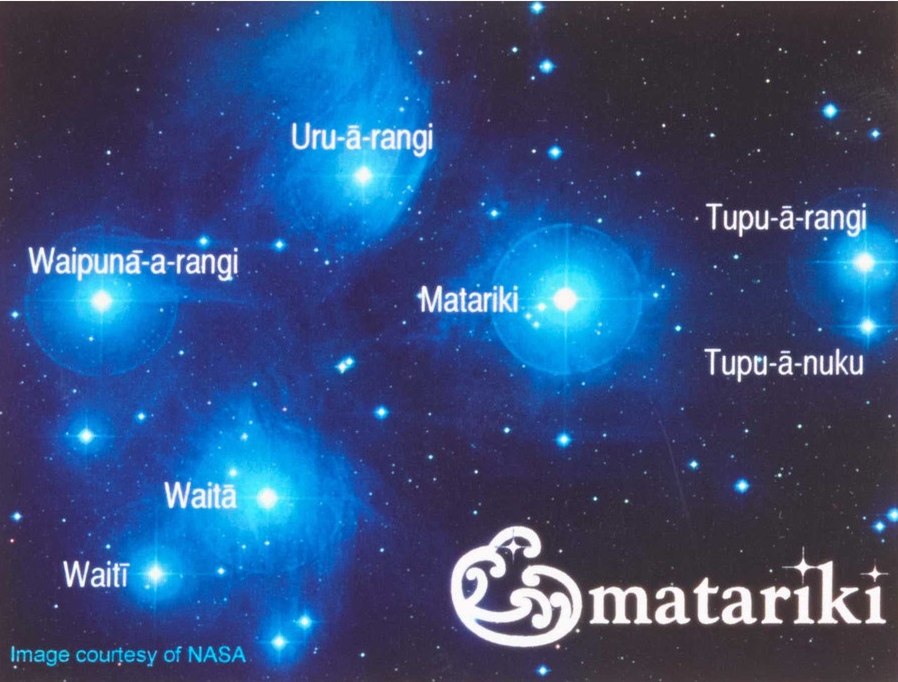
The Seven Sisters, Pleiades, Subaru, 昴宿星團 and Matariki
There are many constellations that take pride of place in the sky. Scorpio and Orion get full marks for likeness. In the South, Crux potently points at the axis of the night sky. My favourite is far from unique and you know it because you've heard its name before: it's a car brand (Subaru) and gives its name to Maori new year (Matariki). I knew it mostly by its Greek appelation, Pleiades, a name I've butchered for far too long. (Try /ˈplaɪədiːz/ or /ˈpliːədiːz/ as indicated by Wikipedia.) They've appeared lucidly in my dreams and sent me out of dreams on early morning hikes to Maungawhau Mount Eden for Matariki observances. The appearance of this constellation before the morning sun rises marks the Maori new year and crowds of people brave the winter cold to spot it before the dawning sun outgleams it. The Matariki observance in 2016 begins 6 June but I didn't wait and went out to see it tonight. It has the most enchanting twinkle.
How do you find it? Find Orion in the North, move your eyes along the plane of his belt through the "V" of Taurus and keep going and.... STOP. You are now in Pleiades. Admire and repeat another night.
Saturday, January 23, 2016
Luminating

It took me a long time to mature as a reader. Despite my ability to focus in chess and language learning, I found it hard to focus and read fiction on a regular basis as I grew up. This really did change in my mid-20s. Perhaps it was the surplus time I had when I was self-employed, or just that other things weren't as interesting at the time. I've since made up for lost time even though there are still huge gaping chasms of books that I would like to have read but probably will never read. There have been some great books in there, as well as Chinese books in the last 6 years. Some books came like cold water. It was Lolita in particular that broke my heart. English was Nabokov's third language and he wrote something so well conceived and written; it disabused me of all those silly little fantasies of being an author. Reading Jin Yong, a Chinese novelist, also had a similar effect on me. Not that I ever though that I was going to be a Nobel Prize winning literary master. Or perhaps I did. I've always been a fabulist.
When I got Dan Carter's biography for Christmas I was lucky in that the giver mentioned it could be exchanged. And I knew exactly what I was going to swap it for: Luminaries by Eleanor Catton. I'm not even an inch into this 800 page novel and I get the same sort of sense as I did with Lolita. Just like Nabokov, it's not just about the ability to write but those awarenesses and knowledges that go into preparing the ideas and imagery: Catton knows the geography, the history, the terminology of mining, social norms and language of the time. She might have researched some of it for all I know but the seamlessness of the background shows that most of it was probably known before as the story formed in her mind. This is just one of many things that come to mind as I read and think.
Naturally, if I ever finish that one novel, I wouldn't be writing in that style. (I meditated on the topic of style more than I wrote.) Writing doesn't need to have the wow of knowledge to construct a potent, meaningful story. It doesn't need complexity and moving parts. Just pitch it to the heart, yeah?
I'm starting "proper" work again soon but writing has been an interesting side project recently, too. I've had the luck to work on a friend's friend's content writing project. It was child's play to someone who likes to write and provided some extra cash during this quiet time. And then there was my on-going tussle with my diploma essay writing. Due to circumstances beyond my control I've had very little supervision of my project work and support for the writing requirements; throw in the fact that my essay writing has never been my strongest suit and you get an interminable saga. I hope I get some signs that my last submission is good enough to scrape over the line.
Words and scribblings, they're all for something or someone. If not they're just hot air. So many times I'm just writing for me, even when they're submitted with a word count, or put into a blog frame. Luminaries was written and stands to be read. And it's a book that I can't want till I have a moment to read more of.
Tuesday, January 12, 2016
Welfare and the Leviathan
"If there is no God, everything is permitted." - Fyodor Dostoevsky

"Are you sad to leave?" I asked in English.
"It's hard to say," he replied in Cantonese, in a tone which was obviously meaning he was happy to leave. New Zealand is not his cup of pu'erh tea. And the fact that a student of English answers in a Chinese way is analogous to how he handles the questions posed by life abroad.
Vinni had been a popular student among teachers. He was apparently approachable, chatty but scratch the surface and you'll find many interesting views. When asked what he wanted to do once he finished his studies he'd replied: "I want to be a landlord." I had only met him once or twice before he headed to New Zealand, and then he came to our reception in Auckland, flying up from New Zealand. He gave us ornate Dragon Phoenix cups as a gift, which was very kind. He had a lot of expensive antiques in his family home in Guangzhou.
It was once he was in New Zealand that I started to frown a little more when I heard his words.
"New Zealand is very corrupt," he mentioned in a text exchange. He went on to explain that there was a student who failed a course and went to the lecturer to cry about her grade and was subsequently allowed to pass. In another incident which irked him, a fellow international student did his own translation of a prerequisite document, explaining that there were no notary offices in his small home country. Vinni railed that this country and society was fit for cheating, that any sensible person would take the chance. And Vinni was sensible.
We contacted him before we returned: "I'm in your industry, too, now," he messaged. He'd set up a business to do the homework that other international students were too lazy or merely unable to do. It was a lucrative loop-niche. He was a very smart person. Later when we finally met him in Wellington, he mentioned that he was invited to a dinner at the Beehive (which he pronounced "behave"). A Green party MP was the main host, but he couldn't remember the name.
In English the word smart is partially synonymous with shrewd and cunning. Chinese has a word that covers all these: 精明. Some of the 精明 behaviours are sometimes unethical or even illegal in western eyes, though. As we chatted over brunch, he listed more things: No one forces businesses to pay GST, so many don't. In fact, one one guy earned a lot of GST free money and kept it in cash on his roof, only for it to be stolen. All $200,000 of it. But the theft wasn't reported because of the questions that might lead the victim into a legal corner. He showed a picture of a set of charity Christmas gifts given to some well-off recent immigrants. Apparently they didn't have jobs and noted a way to get access to Christmas welfare gifts. The way he said it was the key, though: He didn't look down on these 精明 people in these cases. He looked down on the system and society that allowed it.
I said my views on this: We live in a society where there is trust - it's a beautiful thing. This kind of behaviour will slowly destroy it and ruin the image of Chinese (most of the examples he raised were done by Chinese). I mentioned the case from several years ago of a tour group being scheduled into a Christmas charity lunch for the needy, and the impact that it had. You have to fight through paperwork, bureaucracy, rolled eyes, queues, expense to do simple things in China because of that lack of social and bureaucratic trust. Would anyone want that really?
"New Zealand will be like that in ten or twenty years, just like China," he commented later echoing my sentiment. I tried to bite my lip because he wasn't my friend and it was the wrong place. (I only speak English to students, whether they be current or former, and we were in a public place where if I got excited I might say things to implicate others.) I suddenly wanted to release my inner racist mockery, channelling an old white conservative like my father, and tell him and his kind to go back to China, but of course he already was.
He elaborated back on the story about going to the "Behave". Anyone could go in. The security was light. There was no awe to be had in its simple democratic openness. A single Xinjiang/Urewera separatist or ISIS freedom blighter could take out the leadership. The same could never happen in China, where even symbols have the highest security, and the leadership is barely seen. (Everyone dropped their chopsticks when Xi Jinping had his baozi moment.)
The quote in the beginning comes from a Dostoevsky book, The Brothers Karamazov:
"Rakitin now—he doesn't like God, doesn't like Him at all. To people like him, God is a sore spot. But they hide it, they lie, they pretend. 'Will you,' I asked him, 'try to develop these ideas in your literary criticism?' 'They won't let me do it too openly,' he said, and laughed. 'But tell me,' I asked him, 'what will happen to men? If there's no God and no life beyond the grave, doesn't that mean that men will be allowed to do whatever they want?' 'Didn't you know that already?' he said and laughed again. 'An intelligent man can do anything he likes as long as he's clever enough to get away with it. But you, you got caught after you killed, so today you have to rot in prison.' He's real swine to say that to my face; a few months ago I used to throw people like that out of the window. But now I just sit and listen to him."
I think that about him and a lot of people: they somewhere lost their God (which I'll say is their conscience toward any kind of idealised good), they need or worship Leviathanesque power to keep them in check because they themselves cannot. Without scrutiny you are free to take. The welfare they exploit is paid with, not by "the country" but by the taxes they're avoiding. I was glad when that conversation was over so I could get some free air. He was also a 富二代, second generation rich, the son of a highly placed civil servant and expectations of life are quite different.
The other two Chinese friends we saw were adapting well and enjoying the new environment and thriving, paying tax and embracing the difference.
On a slightly different story, I saw a comment on Facebook from some childhood friends that I couldn't help cringe at. They'd bemoaned the fact that they need to pay a holiday service charge "even" on their fruit smoothie from TANK. There has been a failure somewhere in education, eastern or western, to know that it isn't all take-take-take, whether by them or us. Take your time and a half and pay your holiday service fees.
Friday, January 08, 2016
In the air
 New Zealand has advanced and modernised its roading network slowly but surely since I'd been away. There are new expressways (even one or two not recognised on Apple Maps), the tunnel to the North Western motorway is almost connected and other projects are nearing completion and generally things are quicker and smoother. You can avoid bottlenecks like Cambridge and some others like Huntly are in the process. (There could be discussions about the effect this has on small towns, but let's just keep it from the point of view of road users, shall we?)
But the drivers were modernised, too. This was the first time I'd fully utilised GPS as a driver, airbnb, virtual traffic information and smartphones in general. I am rather slow on the uptake of new technology. Probably the most interesting part was our experience of airbnb. It was on a whim that we gave it a try, downloading and setting it up the morning of departure, then booking a place for two nights in Hamilton, and that's when the surprises began.
I guess I'd expected to be in a disused room of a now-abroad child, with the feeling that you were invading someone's privacy by living in their house. This was dispelled pretty quickly. All three places that we stayed in were rooms specially made for the purpose of accommodating airbnb guests, two hosts, despite social and family arrangements, made us feel like friends visiting rather than outsiders; the other one was a bit more aloof and formal (mentioning "it's stated in the listing" whenever we queried things) but even her place you felt at home because that was a big part of her living.
 The two that made us feel most at home had something in common: they are retired or semi-retired couples with the children abroad, certainly a large demographic in New Zealand; they love visitors, we chatted with one couple for about an hour one night, during and after they had guests; and it was clear that airbnb wasn't a personal project of one, both were into it. Both of them provided breakfast, one of them being a luxurious breakfast with homemade muesli, greek yoghurt, milk, strawberries and blackberries, half a banana each and a mandarin. I was served a cup of brewed coffee to go with it. And this was for NZD65 per night. I could also add that they introduced and offered our bookshelf to read from, stupendous views and their vegie patch to take from to cook our evening meal!
We had lots of fun with cats on our journey meeting a total of eight in five homes we visited or stayed in, too. Mr P., in the photo apparently didn't warm to many but we had our moments that floored the hosts.
Could this count as a cat tour? A cloud tour? A real estate tour? A road survey? Well, that's the beauty of road trips. I enjoyed picking blueberries for the first time as well as revisiting places like Puhaha Mt Bruce nature sanctuary, Mt Victoria, Karangahake gorge and Te Aroha spas. I have another two in mind if employment doesn't occupation over my time soon.
Wednesday, December 30, 2015
“Returning to the
source is stillness.”

It has been two weeks since our arrival back and life has
been relatively simple. Of course, not having jobs helps with that simplicity,
with the only inclusion of some job searching and applications each day, you
get nine hours of leisure. Excellent!
What having I been doing, beside Christmas?
- Re-connecting with family and friends
- Eating
- Doing my portfolio for my Diploma (which I thought I was done with but one of my essays in it was considered done for in preliminary marking and was sent back to me to be re-done).
- Content writing for a friend’s enterprise.
- Tossing and interpreting coins in the I Ching.
- Doing the gardening
- Reading the Art of War
- Not exercising
I had intended to have a period of daily exercise upon
coming back. However, inflammation has literally found my Achilles Heel, which
three months on has not Healed. Post New Year, I’ll get an expert in to advise
me. Twice it has seemed to come right only to relapse completely after modest
exertion.
Life is simple, which after twelve of the busiest in my life
is a joy. Soon I’ll be pining for the hustle and bustle.
Saturday, December 12, 2015
Tongue
"New Zealand accent, aside from the short "i" sound, to outsiders is more or less the same," I said. "Although some Australians pronounce "plant" with a sharp "a" like in "ant"."
"Oh, they must have been influenced by America," my friend Colin said.
"Nah, probably influenced by somewhere in England," I remarked and perhaps is a consolidation of my whole insight into dialects and accents.
I'm not a linguistics professor, nor a historian. But slow learning languages and accents themselves, noticing patterns and looking at history have provided me with my own conclusions which I'd like to elaborate here. I'd like to raise a book read aaaagees ago which is worth a read, not for facts but the kind of thinking that can really blow you out of established facts about language evolution. It is The Secret History of the English Language by M J Harper. One of it's simple posits, recalled because I don't have it as a reference right now, is that language is because that's how it was. Evolution, whether biological or linguistic, isn't fast. Even if someone in an ivory tower evolves language, like a Shakespeare or a Bacon, it won't cause the majority of the population to develop a different way of speaking. There is huge buffering against change. That's why, as I'd agree, Middle English didn't evolve out of Old English (as the book stridently puts forward). A language basically like Middle English (think Chaucer) probably came to the British Isles. It probably wasn't the language of the ruling class early on, that must have belonged to another tribe that would be relegated to history. No-one would say the people who wrote in Latin spoke like the early Romans, just as no known region spoke in Classical Chinese, which existed right up to the twentieth century as a means for communication.
And so it was from my experience with Cantonese. It might seem a mystery that there are different accents in different towns just kilometres down the road, but simple when you look at language not as a monolith but as a mass of diverging, interacting units. They're not unlike biological evolutionary units. We're not surprised to see two birds, a kakapo and a kiwi, living on the stretch of land (let alone a sparrow if it should hop by). And it would be a mistake to think that these two derived from an ancestor that once existed on the same strip of land. Such is it with Guangzhou Cantonese and Qingyuan Cantonese. Qingyuan is probably not a Guangzhou colony, but a place settled during the same period of migration by a bunch of different clans. Chinese clans are patrilineal, so I'm currently in a patch of at least two settling families, both called Zhong. Our Zhong family isn't actually Cantonese but naturalised Hakka. The other Zhong family is local Cantonese. By proximity, they speak a similar brand of Cantonese. Women have been married into other towns for millenia but a single woman here and there won't make much difference to the linguistic core and development trend. So probably not in the distant past different families brought their tongue as is to this strip of land in the Pearl River Delta. The fact that they're somewhat similar, mutually understandable, indicates they were part of a similar region from their originating area (the central plains of China). Biologically they can still interbreed.
Hakka dialect can't interbreed in terms of pronunciation or grammar because it's too different. You would learn both separately and choose one to use. They're mutually exclusive for communication purposes. Hakka was a much later mass migration to Guangzhou. The logic is the same but much clearer for Hakka because they're more widely spread: it's hard to imagine them as a single clan. They were another snapshot of central plain Chinese language and culture that spread south in a wave. The wave is important because isolated families that move are unlikely to retain their language. They'd need to assimilate to marry their women out and make alliances. Where there is a wave of migration, there'll be enough other families to support the continuation of the culture and language without the need to rely on others, who won't necessarily give up their own dialect or culture for the sake of others.
And if that weren't incomprehensible enough, I'd like to return to our Ozzie friends and their "plant". My friend was quite rational in his guesses of American influence, but it can't be right. The fact that Americans, almost all Americans, use this pronunciation, indicates that some of the colonisers undoubtedly said it that way. The United Kingdom has all sorts of accents there. Immigrant countries have a lingual lottery from the proportion of peoples from various regions. If the population is small enough, they average themselves out to make a core identifiable accent that is a mean of all the parts, more or less. Australia, in some regions, probably have people from the same areas as the American forefathers who brought the same sound over.
This could be all claptrap, but it's the kind of claptrap I'm glad I have a working theory for. Such things are some of those dirty secrets of the way the world works.
An ode to Qingyuan
 It's my third home, the place of my comfort, where I can sleep and wake without need or want. A place when I'm so secure I can drink beyond my limits. A place where I can walk among the paddy fields. I can talk snakes with the elders as well as spot half-squashed snakes on the roadside. It's a place of geese and chickens. Of tables and tables spilling over everywhere on festive occasions. Of uncles and aunties, all of which I forget to call correctly. Of tea and wine. Of seeing the young'uns grow and grow.
  Qingyuan represents a lot to me. One day, if I were to retire in China, it'd probably be here in a school living in a small place I could walk from and to. It's simple and complicated, it's sweet and it's bitter. It has all the flavours, sights and smells. It represents bridges: I bridged the relationship with my wife's family. But they moreso bridged the gap to me. I tried to pave the way with language even if my language is still a work in progress.


 Where I paved too poorly, there was Second Grandmother. She is a direct neighbor but a distant relative two generations higher. She's had a roughish time of life but doesn't show it a bit. She can take the bitter. She's always smiley to me but has never figured out how to talk to me. She usually greets me in the exact same way as she would another, a rapid, high pitched, loud exuberant connected stream of words, usually a question, that I have no way of answering. Anything beside this I might have had a chance to deal with but she gets discouraged. Usually in her discouragement she speaks slower and I can understand a bit more but she's lost interest.
 There are the ones who've made it across the paved road I've made through a greater effort and openness on their part. Those are definitely my parents-in-law, who've probably dealt with a fair but just because I'm a foreigner but who care for me dearly as I do them and will try tirelessly to communicate. My grandfather-in-law has more to overcome being partially deaf, but still has embraced me and tried to bridge the gap. Others are Aban-go, who is my age and puts the effort in to talk. He doesn't grade down his language, probably because he can't but his desire to communicate means I learned a lot from him (compared to the more helpful but distant, Hou-go, who usually resorts to Mandarin but can't understand my culture or personality nor support me really to understand his); Fourth Kaufu, who's always smiled and tried to communicate (I've blogged about him in the past); Third Uncle the Chef, who I've barely understood anything of in five years but still communicates from the heart.
This has been my final exam of exams for my Qingyuan dialect. Speaking, I still can't freely communicate. It's really disappointing, but my listening is surprisingly good. In all the "reunion" farewells I've followed quite detailed and sophisticated conversations in accented Qingyuan dialect. I can always fall back on good listening and a command of Mandarin in my daily life if I choose so I'm at least happy that I have the tools to deal receptively and actively in rural China. But Mandarin always feels a cop-out here.
Qingyuan, oh Qingyuan, this is my final sleep here for some time. May your charms and hearts remain.
Subscribe to:
Posts (Atom)